


Okay, please see the professional article created based on your requirements and reference content.
Global Practices and Comparative Analysis of Blockchain Applied to Securities Settlement in Major Markets
Keywords: Blockchain, Securities Settlement, Tokenization, DVP, Central Bank Digital Currency, Private Blockchain, Public Blockchain
Introduction
With the rapid development of fintech, blockchain technology is penetrating the core links of financial market infrastructure—securities issuance, clearing, and settlement—with unprecedented depth and breadth. Traditional securities settlement processes involve multiple intermediaries, lengthy procedures, and obvious efficiency bottlenecks. Blockchain, with its features of decentralization, immutability, data sharing, and programmability, provides a new technical path for building a more efficient, transparent, and secure settlement system.
In recent years, central banks, stock exchanges, central securities depositories, and clearing companies in major global economies have launched a series of blockchain-based securities settlement pilot projects. These projects exhibit diverse exploration paths in technology selection (private blockchain, public blockchain), business models (tokenization, parallel ledger), currency forms (central bank digital currency, traditional currency), and settlement mechanisms (DVP, PVP). This article takes the United States, Europe, Singapore, and important cross-border collaborations as examples to systematically review the core characteristics and key insights of these cutting-edge practices, aiming to present readers with a panoramic view of global blockchain securities settlement development.

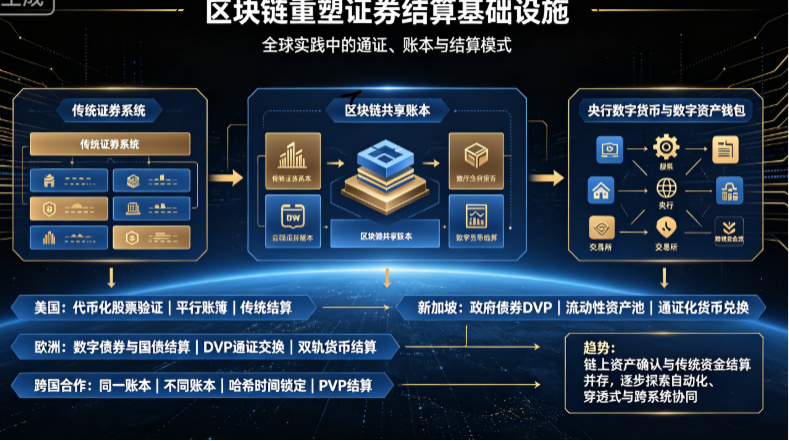
Note: The exploration of technical paths and business models in blockchain securities settlement across major global economies presents diversified characteristics.
Pioneering Experiment in the US: Verifying the Feasibility of Tokenized Stocks
In 2020, the Depository Trust & Clearing Corporation (DTCC) led a landmark experiment aimed at verifying the feasibility of using blockchain technology to support the entire process of stock issuance, clearing, and settlement. The experiment selected a private blockchain as the underlying platform, developed jointly by multiple market institutions and technology companies. This technology choice reflected the cautious consideration of controllability, privacy, and maturity by regulators and the industry at that time.
The most critical design was its unique business model—the tokenized stock platform was not intended to replace the existing system but to run in parallel with the traditional stock settlement platform using a "parallel ledger" model. Transactions were initiated by market participants through client nodes, processed on the tokenized platform, and the final settlement information was sent back to the traditional business system. This approach provided users with diverse options while minimizing the disruptive risk brought by the new technology.
The experiment used traditional currency as the monetary form, with all transaction records ultimately based on the traditional business system. Although this approach limited the autonomous potential of blockchain to some extent, it clearly demonstrated that blockchain technology can serve as an efficient "pre-processor" or "verification layer" for traditional settlement systems, paving the way for deeper exploration.
Multi-path Exploration in Europe: From Private to Public Blockchains
Europe's exploration is characterized by practice-driven innovation, presenting a clear path from private to public blockchains and from single institutions to multilateral collaboration.
Euroclear's Central Bank Digital Currency Settlement Trial began in 2021, where it collaborated with market institutions to simulate settling French government bonds using a central bank digital currency (CBDC) on a private blockchain. The trial validated the effectiveness of DVP (Delivery versus Payment) settlement in tokenized mode—transactions were completed through the exchange of security tokens and currency tokens. Currency tokens were distributed to participant wallets upon issuance for settlement of securities transactions in both primary and secondary markets. Results showed that token-based DVP was as effective as account-based DVP in terms of efficiency and security, providing key evidence for the practical application of CBDC in securities settlement.
Clearstream's Digital Bond Platform Plan represents a systematic restructuring of the entire bond lifecycle. In line with Germany's Digital Securities Act, the platform covers the full value chain of issuance, custody, settlement, and asset servicing. Its technical architecture is particularly noteworthy: the platform consists of four modules—a digital bond issuance module, a central register and custody module based on a private blockchain, a module for "decentralized" services for private securities based on a public blockchain (not yet launched), and a messaging channel module. This "hybrid architecture" design leverages private blockchain to ensure clear ownership and legal certainty for core assets, while aiming for broader liquidity access and automated services through public blockchain, representing a potential mainstream direction. In December 2022, the first digital bond issued by KfW through this platform marked the successful realization of this blueprint.
SIX Swiss Exchange's exploration focused on the diversity of settlement currencies. In a trial jointly conducted with the Swiss National Bank and the Bank for International Settlements, SIX used both digital currency and traditional currency for settlement. When settling with digital currency, the buyer first exchanged traditional currency for digital currency, which was automatically transferred to the seller's traditional account after settlement; when settling with traditional currency, the blockchain platform interconnected with the central bank's Real-Time Gross Settlement system (RTGS) through a "lock and trigger" mechanism to complete the fund transfer. This design ensured the system could accommodate future digital currency scenarios while safely and stably interfacing with the existing central bank currency system.
Singapore's Flexible Application: Cross-chain and Liquidity Pools
The Monetary Authority of Singapore's (MAS) exploration began in 2016, demonstrating strong technical flexibility and business foresight. Early projects focused on the interbank market, exploring DVP settlement for government bonds and Singapore dollars on blockchain. Its most notable feature was the "cross-chain" design—government bonds as digital securities and digital currency were on different blockchains, with separate ledgers for settlement. Although this increased technical complexity, it provided valuable experience for the interoperability of sovereign currency and digital assets across different chains.
In 2022, MAS took its exploration further by establishing a liquidity asset pool on Ethereum. The pool included tokenized Singapore government bonds, Japanese government bonds, yen, and Singapore dollars, and successfully simulated real-time exchange of tokenized yen and Singapore dollars as well as trading settlement of tokenized government bonds. This not only validated the feasibility of real-time settlement in a multi-currency, multi-asset environment but also explored the enormous potential of using blockchain to build a global, 24/7 liquidity network.
Collaboration and Innovation in Cross-border Cooperation
Cooperation between the European Central Bank and the Bank of Japan is a classic case in the field of blockchain securities settlement. In 2016, the European Central Bank and the Bank of Japan jointly proposed and compared two core settlement models: settlement on the same ledger and settlement on different ledgers. In the same-ledger model, securities and funds are recorded on one ledger, and transaction processing is completed directly through cryptographic signatures and consensus mechanisms, with relatively lower risk. In the different-ledger model, securities and funds reside on separate ledgers, requiring Hash Time-Locked Contracts (HTLC) to ensure atomicity—if the required process is not completed within a predetermined time, it automatically rolls back to ensure the safety of both parties' assets. This comparison provided a crucial theoretical framework for global peers to choose technical paths.
Cooperation between the Swiss National Bank and the Bank of France (2021) went further in the multi-currency, multi-asset domain. The Swiss National Bank, the Banque de France, and the Bank for International Settlements, together with market institutions, explored the use of digital Swiss francs and digital euros to settle financial instruments such as stocks or bonds on blockchain. The test covered issuance and redemption of wholesale CBDC, issuance and redemption of traditional securities and their on-chain mapping, DVP settlement on digital exchanges, and PVP (Payment versus Payment) settlement between different digital currencies. This collaboration successfully broke through multiple barriers between "traditional finance" and "digital finance," "single currency" and "multi-currency," and "DVP" and "PVP," serving as an important rehearsal for building a future global digital financial market infrastructure.
Conclusion and Outlook
Taking a panoramic view of global practices, we can see that the application of blockchain in securities settlement has steadily moved from the concept verification stage to partial implementation. The explorations across countries and regions exhibit the following common trends and core insights:
- Technical path serves business goals: Whether private, public, or hybrid blockchain, the choice is made to meet specific needs for regulatory compliance, privacy protection, transaction efficiency, and system controllability.
- Symbiosis with existing systems rather than disruption: Models such as parallel ledgers and interconnection with RTGS systems indicate that the mainstream path is gradual integration with traditional financial infrastructure.
- Central bank digital currency is a key catalyst: Whether in Euroclear's trial or SIX's practice, a central bank-backed digital currency is a crucial element to unlock the full potential of blockchain DVP/PVP settlement.
- Interoperability becomes a key challenge: Cross-chain (Singapore) and cross-ledger (ECB-BoJ) explorations show that a successful digital financial market in the future must be a market where heterogeneous systems can interoperate efficiently and securely.
Looking ahead, with the improvement of legal frameworks (such as Germany's Digital Securities Act), the gradual rollout of central bank digital currencies, and the maturation of cross-chain technology, we have reason to believe that a new generation of global securities settlement system—based on blockchain, achieving T+0, 24/7, low-risk, and high transparency—is gradually moving from blueprint to reality.
Copyright Notice: This article isTailan Global Finance AgencyOriginal content, please contact us for authorization to reproduce.