


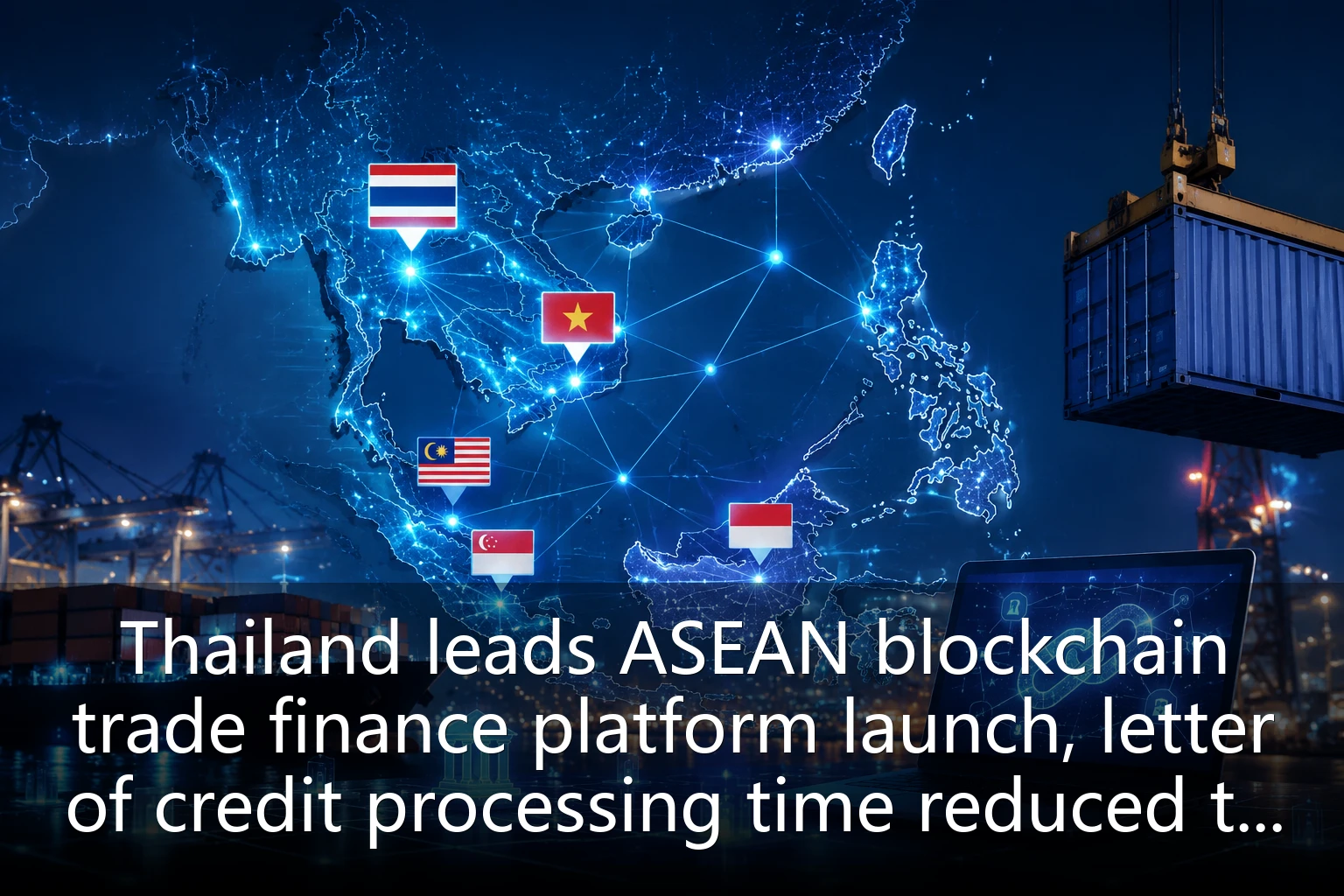
On July 27, 2026, Bangkok - The Bank of Thailand and the Monetary Authority of Singapore jointly announced that the ASEAN Blockchain Trade Finance Platform (ABTFP), developed under Thailand's leadership, officially commenced commercial operations. The first batch of the platform connected 12 major commercial banks from Thailand, Singapore, Malaysia, Vietnam, and Indonesia, marking a new phase in the digitalization of trade finance in the Southeast Asian region.
Technical Architecture and Core Functions
ABTFP is built on Hyperledger Fabric 2.5, connecting customs, port authorities, logistics companies, and banking systems of various countries through a permissioned blockchain network. The platform's core modules include:
- Digitization of Letters of Credit: Paper letters of credit are replaced by smart contracts, with automatic triggering of the entire process from issuance, notification to negotiation, reducing average processing time from 5-7 days to 2 hours.
- Trade Document Verification: Bills of lading, invoices, certificates of origin, etc., are hashed and recorded on the chain, enabling real-time multi-party verification and eliminating forgery.
- Dynamic Credit Rating: Integrates historical transaction data and customs compliance records to provide automated credit limit calculation for small and medium-sized exporters.
Industry Impact and Data
According to preliminary estimates by the Export-Import Bank of Thailand, after full operation, the platform is expected to save regional trade enterprises in ASEAN approximately $3.2 billion in operating costs annually, with small and medium-sized enterprises accounting for over 60% of the benefits. During the pilot phase, United Overseas Bank (Singapore) reduced the error rate of letter of credit processing from 4.7% to 0.3%. Malaysia's Minister of International Trade and Industry stated: "In the past, applying for cross-border trade financing required submitting more than 20 paper documents; now the entire process can be completed via a mobile app."
Regulatory Coordination and Compliance
The platform adopts multi-layer permission control and zero-knowledge proof technology to ensure that regulatory authorities from various countries can audit specific transactions without leaking commercial secrets. The Governor of the Bank of Thailand emphasized at the press conference: "ABTFP complies with the Financial Action Task Force (FATF) Travel Rule on anti-money laundering, and all nodes must pass anti-money laundering compliance certification." In addition, the platform supports real-time settlement in multiple currencies, connecting national real-time gross settlement systems to achieve instant clearing of Thai baht, Singapore dollar, Malaysian ringgit, and other currencies.
Ecosystem Expansion Roadmap
According to the project plan, it will be opened to all ten ASEAN member states in the first quarter of 2027, and plans to conduct cross-chain interoperability tests with China's blockchain trade finance platform "Trade Link". At the same time, the development team is testing smart contract payment functions based on central bank digital currencies, which in the future can automatically transfer payments from the importer's digital wallet to the exporter's account.
Expert Opinion
Professor Chen Weilun of Finance at the National University of Singapore pointed out: "ABTFP solves the inefficiency of 'document mountains' that have long plagued Asian trade; its true value lies in shifting trust from paper to code. If integrated with digital identity systems, the ideal state of 'transaction equals settlement' may even be realized in the future." However, he also cautioned that differences in data sovereignty laws among countries remain a major challenge, requiring higher-level political coordination.
As of press time, the Thai baht appreciated slightly by 0.2% against the US dollar. Market analysts believe this event boosted investor confidence in Thailand's fintech capabilities.

Copyright Notice: This article isTailan Global Finance AgencyOriginal content, please contact us for authorization to reproduce.