

Title: Tech Titans Reshape Markets: SpaceX's Ascent, Chip Dynamics, and AI Ecosystem Evolution
Keywords: SpaceX IPO, Nvidia debt issuance, Micron, Mobileye robotaxi, Apple AirPods camera, Android 17 AI features, market capitalization
Introduction
On Tuesday, the U.S. stock market witnessed a seismic shift in the technology sector as a new entrant—SpaceX—rocketed into the ranks of the world's most valuable companies. Its debut on the Nasdaq has not only captured investor imagination but also highlighted a broader narrative: the relentless innovation in artificial intelligence, autonomous systems, and next-generation hardware is redrawing the competitive landscape. From semiconductor giants like Nvidia and Micron navigating capital markets and product cycles, to Apple and Google embedding AI deeper into consumer devices, the day's trading activity reflected a market in transition. This article delves into the technical and strategic implications of these events, exploring how each development fits into the larger mosaic of the tech ecosystem.
SpaceX's Meteoric Rise and Market Impact
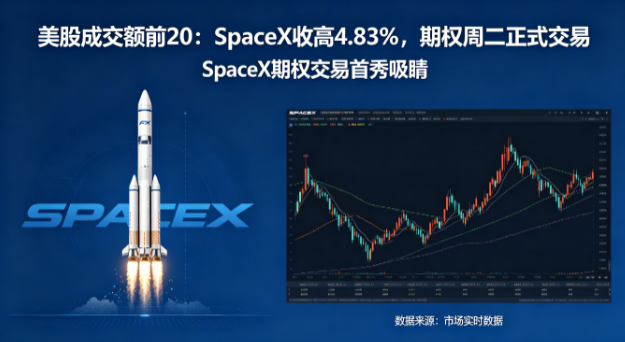
SpaceX closed Tuesday with a 4.83% gain, trading at $201.8 per share, lifting its market capitalization to an astonishing $2.64 trillion. The company has now soared nearly 50% above its IPO price within just three trading days, briefly surpassing Amazon and Microsoft in market value. This rapid ascension is unprecedented even by tech standards, underlining the market's conviction in SpaceX's ambitious vision: a vertically integrated space transportation and satellite broadband monopoly.
The launch of SpaceX options on the same day provided a new layer of liquidity, allowing both institutional and retail investors to hedge or speculate. With intraday trading volume exceeding $340 billion—several times the combined volume of Nvidia, Microsoft, Tesla, and Apple—SpaceX has become the new epicenter of market activity. Technically, the company's valuation implies a price-to-sales multiple that rivals the most aggressive growth stocks. Yet, its business fundamentals are equally compelling: Starlink now serves over 4 million subscribers globally, and the Starship program promises to reduce launch costs by an order of magnitude. For investors, SpaceX represents a pure play on the commercialization of low-Earth orbit, a market expected to exceed $1 trillion by 2040.
Semiconductor Sector: Nvidia's Debt and Memory Chip Volatility
Nvidia slipped 2.37% to $259 billion in turnover, even as the company issued $25 billion in corporate bonds—its first public debt offering since June 2021. Over the past five years, Nvidia has transformed from a GPU vendor to a $5 trillion AI juggernaut, commanding over 80% of the AI accelerator market. The bond issuance, coming at a time when the company's free cash flow exceeds $50 billion annually, appears to be a strategic move to lock in low financing costs for future scaling, including new fab capacity and R&D in next-generation architectures like Blackwell Ultra.
In contrast, Micron Technology fell 6.18% with $472 billion in volume, reflecting ongoing oversupply concerns in the memory market. Micron's HBM (High Bandwidth Memory) products are critical for AI servers, but the broader DRAM and NAND segments face pricing pressure as demand from smartphones and PCs remains tepid. Meanwhile, SanDisk dropped 5.52% and Marvell Technology declined 9.78%, both indicating a rotation out of lagging chip stocks into more AI-exposed names.
The bond market signal from Nvidia, however, is a double-edged sword: while it strengthens Nvidia's balance sheet, it also suggests that management sees a need for aggressive capital expenditure to maintain its competitive moat—a bet that will be tested as AMD and custom ASICs (like Google's TPU) gain traction.
Autonomous Driving: Mobileye's Robotaxi Ambitions
Tesla fell 1.58% despite the broader automotive sector news. The real headline came from Mobileye, an autonomous driving technology supplier, which announced plans to launch its own robotaxi service in the United States. The company aims to deploy 100 autonomous taxis in a major U.S. city by 2027, scaling to approximately 17,000 vehicles within five years. This marks a significant departure from Mobileye's traditional business model as a Tier 1 supplier of driver-assistance chips and software.
Technically, Mobileye's approach relies on its EyeQ system-on-chip combined with a hybrid mapping strategy—unlike Tesla's vision-only or Waymo's HD-map-heavy solutions. By owning the service layer, Mobileye can capture more of the value chain and accelerate data collection for its true-redunancy sensor fusion. For the broader autonomy ecosystem, this signals a maturation: after years of pilots, robotaxi operators are now targeting commercial viability. However, regulatory hurdles and unit economics remain daunting. The 2027 timeline suggests a cautious ramp, but if successful, Mobileye could disrupt both ride-hailing and automotive component markets.
Apple's Vision: AI Wearables and Future Products
Apple rose 0.95% on $119 billion in volume. The company disclosed plans to launch a camera-equipped AirPods by late 2027, positioned as its first AI wearable. The earphones will incorporate a computer vision camera as a sensing component, providing Siri with real-time visual context—enabling features like object recognition, gesture control, and environment-aware audio. This aligns with Apple's broader strategy of embedding AI at the edge rather than relying solely on cloud processing.
The camera AirPods are part of a multi-product roadmap that includes a foldable iPhone and a commemorative edition device. More critically, Apple is developing next-generation chips using advanced process nodes (likely 2nm and beyond) for future wearables, and plans to launch its first smart glasses as early as 2026. The smart glasses—expected to compete with Meta's Ray-Ban Stories and Google's upcoming glasses—will combine spatial computing with AI assistants. From a technical perspective, Apple's advantage lies in its tight integration of hardware, low-level software, and privacy-preserving on-device AI. The camera AirPods could be the Trojan horse that normalizes augmented audio-visual experiences, paving the way for true AR glasses later.
Google's Android 17: AI at the Core
Alphabet (Google) gained over 1% with $90.83 billion in turnover. Google officially released Android 17, the latest major update to its mobile operating system. While the update brings improvements in multitasking, social video creation, and gaming, the most transformative features—Gemini Intelligence, a redesigned Emoji set, smarter voice input, and "Vibe Coding" widgets—are slated for a phased rollout starting summer 2025.
Android 17's architecture lays the groundwork for "agentic AI," where on-device models can autonomously perform tasks across apps. For example, Gemini Intelligence will enable natural language commands to edit photos, book rides, or compose messages without manually switching apps. The "Vibe Coding" widget allows users to generate simple applets using conversational prompts, lowering the barrier for user-level automation. Google's strategy is to make AI an integral part of the OS, not an add-on app. This mirrors Apple's approach but differs in openness: Google will offer these capabilities to all OEMs, potentially accelerating AI adoption across the Android ecosystem. The phased rollout suggests Google is cautious about reliability and privacy, but once fully deployed, Android 17 could redefine mobile interaction paradigms.
Conclusion
Tuesday's market activity underscores a defining moment in technology: the convergence of space commercialization, semiconductor rebalancing, autonomous mobility, and AI-infused consumer electronics. SpaceX's unprecedented valuation validates the demand for space infrastructure, while Nvidia's debt issuance signals that even leaders must invest aggressively. The chip sector's volatility reflects a bifurcation between AI winners and memory losers. Mobileye's robotaxi pivot and Apple's camera AirPods point to a future where AI and sensing are ubiquitous, and Android 17's agentic AI features promise to make every phone a smart assistant. For investors and technologists alike, the common thread is clear: the companies that control the intersection of hardware, software, and AI will define the next decade. As these titans jostle for position, the market will remain a high-stakes arena where innovation and capital are inextricably linked.
Copyright Notice: This article is original content of Dhaka Bullion. Please contact us for republication permission.

