


Shared Ledger: Swift's Digital Bridge Ushering in a New Era for Global Finance
Keywords
Swift Shared Ledger; Tokenized Deposits; Cross-Border Payments; Blockchain Technology; Financial Innovation
Introduction
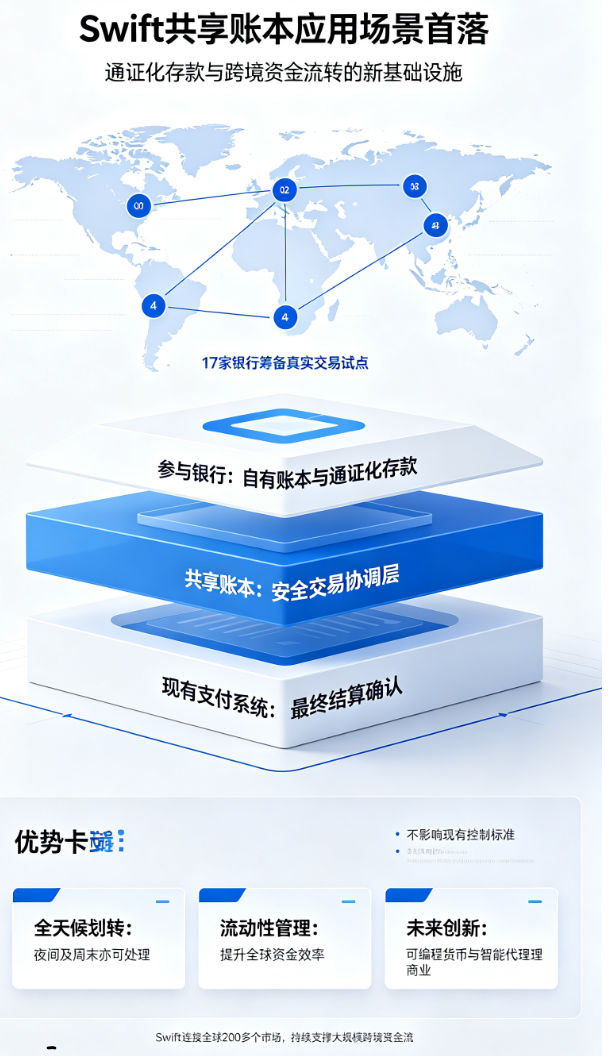
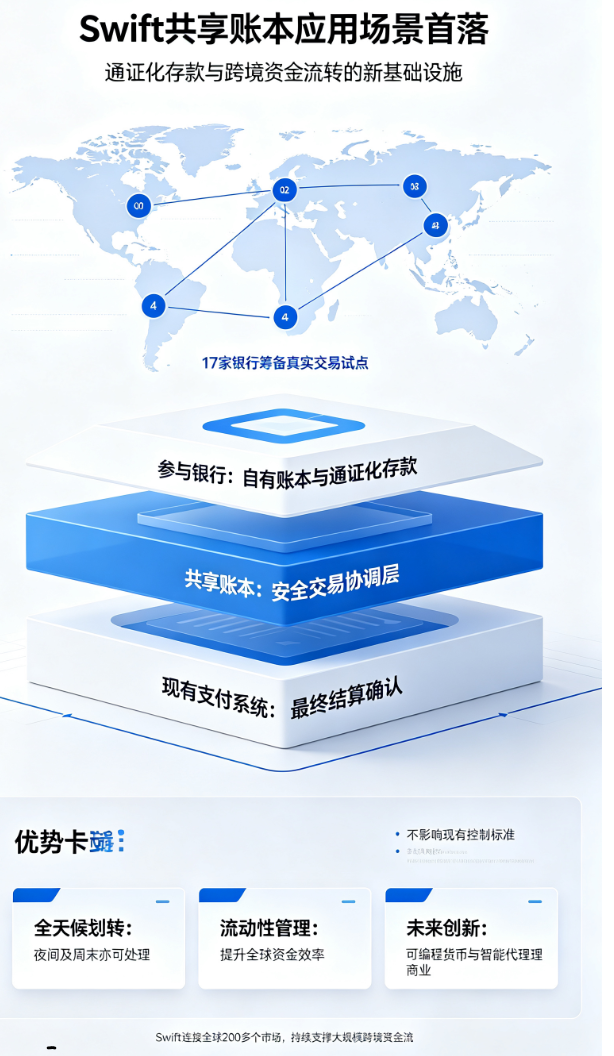
The global financial system stands at the crossroads of digital transformation. With the maturity of emerging technologies such as blockchain and distributed ledger technology (DLT), the underlying logic of traditional cross-border payments and fund transfers is undergoing profound change. In July 2026, Swift (Society for Worldwide Interbank Financial Telecommunication) announced a milestone: 17 banks across six continents are preparing to initiate real-transaction trials based on the Swift Shared Ledger. This marks a critical step for global financial infrastructure in the digital age and delivers the first substantial achievement of the shared ledger plan unveiled in 2025.
From the trust foundation of traditional finance to the innovation frontier of digital finance, Swift represents more than a simple technology upgrade — it is a structural shift in the global financial ecosystem. This article delves into the far-reaching significance of the Swift Shared Ledger from four dimensions: technical architecture, market value, industry impact, and future outlook.
1. Technical Architecture: Innovative Design of the Shared Ledger
The Swift Shared Ledger is a shared platform that provides a secure transaction coordination layer for participating banks. Unlike traditional payment systems, this ledger does not seek to replace banks' existing internal ledgers but rather builds a unified, trusted coordination layer on top of them. Its core function: to support banks' own tokenized deposits issued on their ledgers, enabling fund transfers for customers — including overnight and weekend hours — with final settlement through existing payment systems.
The elegance of this design lies in balancing "compatibility" and "expansion." On one hand, the shared ledger retains existing financial system compliance, credit, risk management, and control standards, ensuring financial safety and stability. On the other hand, it breaks the temporal and spatial limits of traditional cross-border payments. While traditional payment systems often halt during non-business hours, the shared ledger enables 7×24 uninterrupted fund flow.
From a technical perspective, the Swift Shared Ledger adopts a consortium blockchain governance model, with Swift as the neutral platform operator and participating banks as node maintainers. This design avoids the compliance and performance shortcomings of public blockchains while offering stronger interoperability than private blockchains. The tokenized deposits on the shared ledger are not newly issued digital currencies but digital certificates issued by banks on their own balance sheets and held by depositors, strictly pegged to fiat currency value to ensure financial stability.
The implementation of this technical architecture was not achieved overnight. After unveiling the shared ledger plan in 2025, Swift quickly integrated feedback from multiple global financial institutions, undergoing rounds of requirements analysis, prototype testing, and security audits before finalizing the current design. With connections to over 200 markets worldwide, Swift transmits funds equivalent to global GDP every two to three days — this near-astronomical transaction processing capacity provides a solid technical foundation for its shared ledger.
2. Market Response: Active Support from 17 Banks Across Six Continents
The real-transaction trial has attracted 17 banks from all six continents — a number with profound symbolic significance. It not only reflects strong market demand for new features enabled by Swift's technology system but also sends a clear signal: the global banking industry is ready to embrace the era of tokenized assets and digital payments.
The participating banks represent both developed economies and emerging markets, including major financial institutions from Europe, North America, Asia Pacific, Africa, Latin America, and Oceania. This broad regional distribution shows that the Swift Shared Ledger is not tailored to any specific market but is a universal solution for the global financial system.
The banking industry's active support is no coincidence. In recent years, the development of cryptocurrency and stablecoin markets has brought innovative ideas but also exposed many issues, such as high price volatility, regulatory gaps, and insufficient customer protection. The advantage of the Swift Shared Ledger lies in combining the trust foundation of traditional finance — Swift has operated for over half a century without a major security incident — with the efficiency and flexibility of digital currencies. This "trust + innovation" combination is exactly the digital upgrade path the banking industry has been hoping for.
Thierry Chilosi, Swift's Chief Business Officer, commented: "With new blockchain ledger capabilities, Swift is extending the trust and stability that traditional finance has built over decades to the digital currency space. This capability enables tokenized value to move across borders with the speed and flexibility required by modern business, while maintaining the high levels of resilience, security, and compliance demanded by the global financial system. The strong support from the banking industry fully demonstrates the real value of this solution."
3. Industry Value: Paradigm Shift in Tokenization and Cross-Border Payments
The Swift Shared Ledger's application scenarios focus first on cross-border payments of tokenized deposits. "Tokenized deposits" refer to traditional bank deposits represented in digital form, enabling efficient flow on blockchain networks. This technology brings three fundamental enhancements to cross-border payments:
Breakthrough in Time Dimension: Traditional cross-border payments involve multiple steps (sending bank, correspondent bank, clearing system, receiving bank) and often face delays during non-business hours until the next working day. The Swift Shared Ledger provides 7×24 uninterrupted service, allowing businesses to manage global liquidity more flexibly. For example, if a multinational company headquartered in New York has its Thai subsidiary needing to make an emergency payment to a supplier at 2 a.m. Thailand time, under the traditional system there would be at least a one-day delay, while the shared ledger enables instant settlement.
Improved Liquidity Management Efficiency: In the traditional model, banks need to set aside large liquidity reserves for cross-border payments to handle uncertain settlement windows. The shared ledger's real-time settlement mechanism allows banks to manage fund positions more accurately, significantly reducing liquidity costs. According to industry forecasts, this technology could save the global banking industry hundreds of billions of dollars in liquidity costs.
Optimized Customer Experience: Without affecting existing payment process standards for compliance, credit, risk management, and controls, the shared ledger enhances customer experience. For corporate clients, this means faster fund availability, more transparent fee structures, and more flexible scheduling; for individual users, it may mean lower fees and more convenient cross-border remittance.
It is worth noting that the Swift Shared Ledger does not aim to upend the existing payment system but serves as a "digital bridge" for seamless integration between traditional and digital finance. This path of gradual innovation avoids drastic shocks to the financial system while laying the foundation for full digitalization in the future.
4. Future Outlook: Programmable Money and Agentic Commerce
The significance of the Swift Shared Ledger goes far beyond current payment scenarios. Thierry Chilosi noted that the technology "not only helps further unlock the advantages of digital value globally but also lays the foundation for future innovative applications such as Programmable Money and Agentic Commerce."
Programmable Money refers to digital currency that can automatically execute according to preset rules — for example, payments, dividends, or cross-border tax payments triggered automatically under certain conditions. The tokenized deposits on the Swift Shared Ledger provide a reliable vehicle for programmable money: tokenized deposits themselves are digital representations of fiat currency, retaining the legal attributes and value stability of fiat while offering programmability through code.
Agentic Commerce is an even more forward-looking concept. In the era of Web3 and AI convergence, fund flows will no longer rely entirely on manual commands. Intelligent agents can automatically complete high-frequency transactions such as micro-payments, supply chain financing, and insurance claims on behalf of users or businesses. The Swift Shared Ledger, as a global unified transaction coordination layer, provides secure and efficient underlying infrastructure for these automated fund flows.
From a broader perspective, the Swift Shared Ledger technology marks a strategic transformation of traditional finance in the digital age. The global financial system is evolving from a binary structure of "information transmission + fund settlement" to a ternary structure of "information + digital value + smart contracts." Leveraging its dominant position in information transmission, Swift is extending its influence to the digital value domain, which will undoubtedly have profound implications for the competitive landscape of global finance.
Conclusion
From 17 banks preparing real-transaction trials to the first application scenario of the Swift Shared Ledger plan, global financial digitalization is reaching a critical turning point. With over half a century of operational experience, a network covering more than 200 markets, and deep trust from global financial institutions, Swift has built a solid digital bridge for tokenized deposits and digital payments.
The significance of this bridge lies not only in improving the efficiency and flexibility of cross-border payments but also in introducing digital genes into the traditional financial system — embracing programmability and automation while maintaining security, stability, and compliance. As Thierry Chilosi stated, Swift is extending traditional finance's trust to the digital currency space, which may be the optimal path for the global financial system to move toward a new generation of digital financial infrastructure.
For the banking industry, the business community, and regulators, the Swift Shared Ledger represents not just technological innovation but a conceptual and paradigmatic shift. In this wave of financial digitalization, those who understand and embrace this change first will gain a competitive edge in the future global financial system. The Swift Shared Ledger is painting a grand picture connecting tradition and the future, trust and innovation — and the full realization of this picture has only just begun.

Copyright Notice: This article isTailan Global Finance AgencyOriginal content, please contact us for authorization to reproduce.