

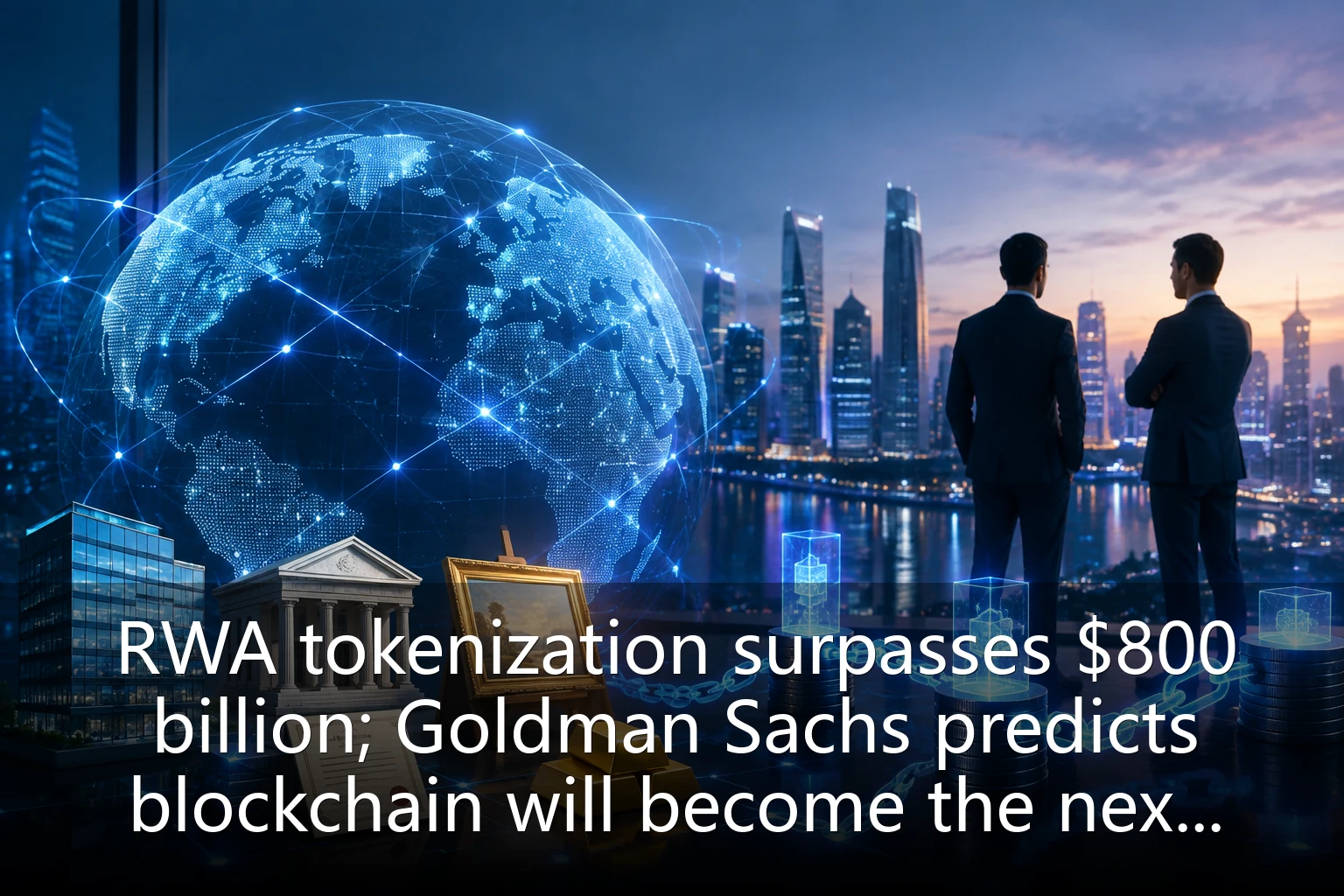
August 4, 2026, marks a significant milestone for global financial markets. According to the latest report jointly released by renowned international consulting firms BCG and Addison Group, the global tokenization of Real World Assets (RWA) has historically surpassed the $800 billion mark as of the end of Q2 2026. This data signifies that blockchain technology has officially moved from the "experimental phase" to the "mainstream financial infrastructure phase," answering the core question for global investors: "Why invest in blockchain?"
Behind the $800 Billion Scale: The Full-Scale Pivot of Traditional Financial Giants
For a long time, blockchain and cryptocurrencies were viewed as fringe experiments by the traditional financial world. However, the market landscape in 2026 has undergone a fundamental reversal. The report indicates that institutional funds flowing into the RWA tokenization market exceeded $320 billion in the past six months alone. Sovereign bonds, commercial paper, real estate mortgages, and private equity constitute the four core asset classes.
Goldman Sachs explicitly stated in a recent research report: "Blockchain is not just a ledger technology; it is the next mainstream financial settlement layer." Similarly, UBS and BlackRock are accelerating the global deployment of their tokenized funds. This full-scale pivot by traditional financial giants not only injects massive liquidity into the blockchain ecosystem but also leverages their global credit to endorse the technology, completely dispelling previous market compliance concerns.
Why Invest in Blockchain? An In-Depth Analysis of Four Core Investment Values
For readers of Tailand Global Finance, especially those focused on Southeast Asia and cross-border investments, understanding blockchain's investment value is crucial. The reason blockchain can become the wealth code of the next era is based on the following four core logics:
1. A Revolutionary Leap in Settlement Efficiency
In the traditional financial system, cross-border payments and securities settlement typically require T+2 or even T+3 days, relying on the Swift network and multiple intermediary clearing houses. Smart contracts based on distributed ledgers can shorten this process to mere seconds. Goldman Sachs' pilot project proved that settling government bonds via blockchain not only compresses time costs by nearly 99% but also significantly reduces counterparty risk. For Southeast Asian economies heavily reliant on cross-border trade, this means a massive improvement in capital turnover efficiency.
2. Unlocking Asset Liquidity and Inclusive Finance
Previously, commercial real estate or infrastructure projects worth tens of millions of dollars were inaccessible to ordinary investors. Blockchain asset tokenization divides large physical assets into digital certificates worth pennies. This fractionalized investment not only releases the liquidity of trillions in idle assets but also allows small and medium investors in Southeast Asia to participate in top-tier global asset allocation with an extremely low barrier to entry for the first time.
3. Transparency and Trust Through Immutability
In supply chain finance and trade finance, information asymmetry and fraud have long been persistent problems. Blockchain's immutability ensures every asset transfer leaves a publicly verifiable record on-chain. The blockchain trade finance platform previously launched by Thailand, leading ASEAN, has successfully reduced letter of credit processing time to 2 hours, serving as a prime example of establishing machine trust.
4. Hedging Against Fiat Devaluation and Geopolitical Risk
Amid global macroeconomic volatility, some Southeast Asian nations face pressure from local currency devaluation. Decentralized digital assets like Bitcoin, with their anti-inflationary properties and fixed supply, are becoming crucial tools for cross-border capital to hedge against single fiat currency risks. Bitcoin's return to a high of $160,000 in 2026 is market validation of this logic.
New Opportunities in the Southeast Asian Market: From Passive Acceptance to Proactive Layout
Facing the $800 billion RWA market dividend, Thailand and other Southeast Asian countries are actively seizing the initiative. Thailand's SEC recently accelerated the approval of compliant RWA platforms, allowing local funds to issue tokenized real estate investment trusts globally via blockchain technology. Meanwhile, Singapore's Project Guardian has entered its third phase, fully integrating foreign exchange, fixed income, and credit assets into the blockchain settlement network.
The Tailand Global Finance analysis team points out: "For cross-border investors, this is a critical window period to position in the blockchain sector. Do not limit your focus solely to secondary market speculation in cryptocurrencies; pay more attention to blockchain infrastructure companies providing underlying settlement protocols, asset custody services, and compliant RWA issuance platforms. These companies are like the 'road builders' of the digital age—no matter which assets go on-chain, they can collect stable 'tolls.'"
Investment Strategy Advice: How to Capture the Blockchain Settlement Layer Dividend?
Given the current market enthusiasm, investors should remain rational and adopt a diversified allocation strategy:
- Allocate Core Crypto Assets: Bitcoin and Ethereum, as the foundational consensus assets of the blockchain ecosystem, should constitute 5%-10% of the investment portfolio, serving as the Beta return basis for the entire sector.
- Focus on RWA Concept Tokens: Prioritize protocol tokens deeply tied to traditional financial assets, such as Centrifuge and Ondo Finance, which directly benefit from the asset on-chain trend.
- Position in Compliant Financial Infrastructure: Pay attention to blockchain fintech companies providing institutional on-chain KYC, asset custody, and settlement services, as these enterprises possess extremely strong moats.
In summary, the $800 billion RWA market scale is just a starting point. As blockchain technology is formally established as the next mainstream settlement layer, a financial infrastructure reconstruction comparable to the internet revolution is unfolding. For investors, understanding the investment value of blockchain is the key to mastering the future financial world.
Copyright Notice: This article isTailan Global Finance AgencyOriginal content, please contact us for authorization to reproduce.