


Blockchain Empowers Commodity Circulation: "Cangdeng Chain" Ushers in a New Era of Digital Warehouse Receipts
Keywords: Cangdeng Chain; Blockchain digital warehouse receipts; All-cangdeng; Commodities; Trust interconnection
Introduction: From Paper Warehouse Receipts to "On-chain Assets"
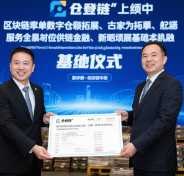
The commodity circulation sector has long faced a core pain point: traditional warehouse receipts, as proof of cargo ownership, struggle to unlock their financial and trade value due to information silos, forgery risks, and inefficient circulation. Recently, spearheaded by the National Commodity Warehouse Receipt Registration Center (hereinafter referred to as "All-cangdeng"), and with collaboration from China Storage Development Co., Ltd., Bank of Communications, Shanghai Data Group, National Blockchain Technology Innovation Center, and other parties, the "Cangdeng Chain" based on the national blockchain network "Hangmao Chain" has officially gone live. Simultaneously, the first batch of non-ferrous metal blockchain digital warehouse receipt businesses, issued by China Storage Global Futures Delivery Business Headquarters and registered with All-cangdeng, were landed in Shanghai, achieving a full lifecycle "on-chain" closed loop covering issuance, registration, and cancellation. This marks that the Cangdeng Chain has moved from infrastructure construction to substantive business operation, providing a new path for digital upgrading of the commodity industry.
1. Cangdeng Chain Builds a "Trusted Channel": From Information Interconnection to Trust Interconnection
Traditional digitalization of warehouse receipts has long stalled at internal information entry within warehouse systems. Trade systems, warehouse systems, and banking systems each form isolated islands with inconsistent data formats, disconnected interfaces, and prominent issues of information lag and verification difficulty. A paper warehouse receipt requires multiple manual checks during circulation, not only time-consuming and labor-intensive but also spawning risks like duplicate pledges and fake receipts due to information asymmetry.
The completion of the Cangdeng Chain builds a "trusted channel" for commodity circulation. Without altering existing business practices, All-cangdeng uses blockchain native architecture to incorporate receipt ownership, business status, and key credentials into a unified trusted framework. Smart contracts drive automatic execution at key nodes, with receipt information recorded on-chain, real-time traceable, and verifiable by multiple parties. This design is essentially a paradigm upgrade from "information interconnection" to "trust interconnection": data is uploaded once, shared by multiple parties, and universally queryable, providing a unified trust anchor for cross-entity collaboration.

The above diagram shows the technical architecture of the Cangdeng Chain, visually demonstrating how blockchain connects warehouse systems, trade systems, and financial systems to achieve data integration and trust co-building. On a deeper level, the value of the Cangdeng Chain lies in establishing a "consensus as a service" underlying capability for the industry. In the traditional model, trading parties rely on their own credit assessments and cross-verification of paper documents, resulting in low efficiency, high costs, and high risks. The Cangdeng Chain embeds cross-institutional, cross-regional trust verification logic into on-chain infrastructure, preliminarily achieving the leap from "information interconnection" to "trust interconnection."
2. Blockchain Digital Warehouse Receipts Create "Asset Credit": Clear Ownership and Efficient Circulation
Traditional electronic warehouse receipts are often "post-hoc on-chain" – issued offline, manually entered, then written onto the chain, essentially still within the framework of paper documents. The breakthrough of blockchain digital warehouse receipts is that receipts are created on-chain from the moment of generation, with warehouse data synced in real time. Key elements such as ownership, quantity, and location are fully recorded on-chain, immutable and uniquely verified. This means the receipt is no longer a static certificate but a digital asset carrier that circulates efficiently, undergoes continuous verification, and is securely used among ecosystem parties.
This transformation directly addresses the core concerns of trading companies, warehouse operators, and financial institutions. A representative from CITIC Global Trading Co., Ltd. said: "Previously, after goods entered the warehouse, paper receipts were cumbersome to archive, and subsequent transfers or financing required repeated document preparation. Now, registering nickel products on the Cangdeng Chain not only reduces risks like duplicate pledges, fake receipts, and single-goods-multiple-sales, but also improves the efficiency of subsequent operations like pledge financing and transfer transactions." A representative from Shanghai Wurui Metal Group Co., Ltd. also noted: "As a trading company, our biggest worry is unclear cargo ownership causing counterparties to hesitate to accept orders. After registering copper products on the chain, blockchain technology leaves a full trace for each receipt, and partners can verify online. This gives us a more reliable credit foundation for cross-regional commodity trading, helping accelerate goods turnover and trade rhythm."
Warehouse operators also benefit greatly. The head of China Storage Global Futures Delivery Business Headquarters commented: "Traditional paper receipts have high anti-counterfeiting costs, low customer trust, and issuing duplicates and delivering them consumes significant manpower and materials. After adopting blockchain digital warehouse receipts, receipt information is natively recorded on-chain and uniformly registered with All-cangdeng, eliminating the need for multiple paper documents. Customers can independently verify inventory and ownership information on-chain, and the entire process of issuance, registration, and cancellation is recorded and controlled, reducing anti-counterfeiting, coordination, and trust costs from the source."
3. From Business Landing to Value Release: Policy Drive and Ecosystem Expansion
The landing of blockchain digital warehouse receipts is not an isolated event; it falls under the policy framework where the state vigorously promotes the application of blockchain and electronic documents. In the first half of this year, the national "15th Five-Year Plan" outline explicitly proposed implementing the national blockchain network construction project. Ten national departments jointly issued the "Regulations on Promoting and Regulating the Application of Electronic Documents," further promoting the application and standardized development of electronic documents at the national level. Shanghai's "15th Five-Year Plan" clearly proposes building the Shanghai hub of the national blockchain network. Meanwhile, documents such as the "Shanghai Several Regulations on Promoting Pudong New Area to Use Blockchain to Empower Electronic Document Applications" and the "Implementation Plan of the National Digital Economy Innovation Development Pilot Zone (Shanghai)" also require support for advancing blockchain infrastructure construction and accelerating the landing application of electronic documents, trusted data, and business collaboration in commodity circulation.
The launch of the Cangdeng Chain and the landing of blockchain digital warehouse receipts further expand the application of the Hangmao Chain ecosystem in commodity scenarios and provide new infrastructure support for warehouse receipts serving physical trade and supply chain finance. In the future, All-cangdeng will continue to collaborate with all parties in the industry chain, closely follow the national strategic direction of continuously promoting blockchain innovation applications and digital infrastructure construction, drive the expansion and increase of warehouse receipt registration, further expand application scenarios such as pledges, transfers, and transactions, and unlock greater value of warehouse receipts in commodity circulation.
Conclusion: Trusted Infrastructure Supports the Construction of a Unified National Market
From a technical perspective, the successful launch of the Cangdeng Chain is not only an important breakthrough in the application of blockchain technology in the commodity sector but also a reshaping of "asset credit" from paper credentials to digital assets. It transforms warehouse receipts from information silos to data connectivity, from manual trust to algorithmic trust, and from partial optimization to systemic restructuring. When the ownership, status, and circulation of receipts are transparently verifiable on-chain, the efficiency of commodity circulation will be greatly improved, financial risks will be significantly reduced, and cross-regional, cross-entity trade collaboration will have a more solid foundation. Leveraging the Cangdeng Chain as a trusted, efficient, and traceable infrastructure, China's commodity market is accelerating toward high-quality development, providing solid underlying support for the construction of a unified national market.

Copyright Notice: This article isTailan Global Finance AgencyOriginal content, please contact us for authorization to reproduce.