
Title: NVIDIA's AI Factory Vision: Token Economy, Vera Rubin, and the Next Wave of Physical AI
Keywords: NVIDIA, Jensen Huang, AI factory, token economy, Vera Rubin, physical AI, shareholder returns
Introduction
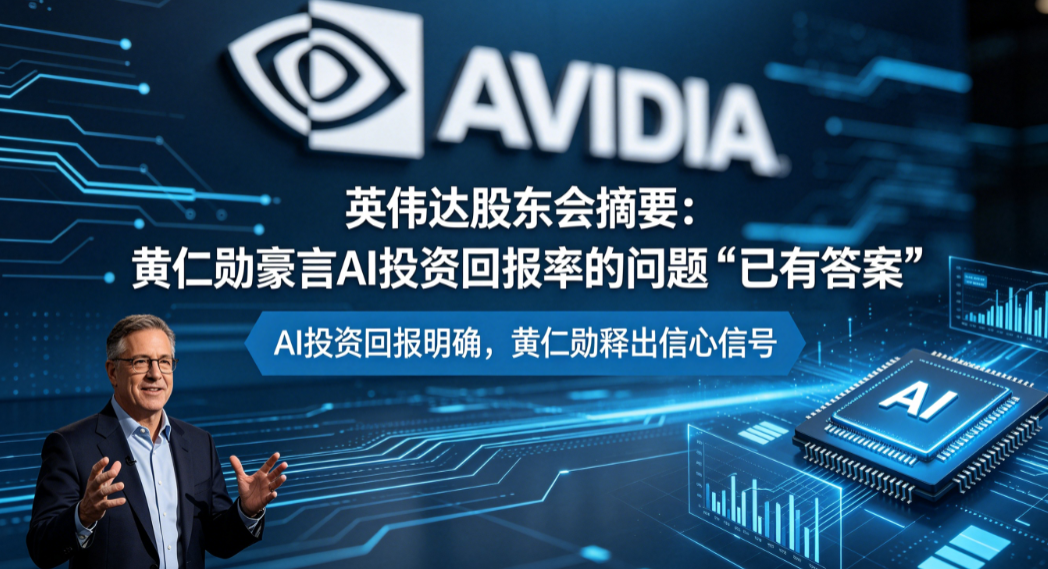
At its annual shareholder meeting on Wednesday, NVIDIA, the world’s most valuable publicly traded company, delivered a resounding message: the era of useful, profitable artificial intelligence is here. CEO Jensen Huang, the iconic leader of the AI revolution, used the platform to articulate a compelling vision—one in which data centers evolve into "AI factories" that manufacture tokens, the fundamental units of intelligence. With a record-breaking financial performance and a clear roadmap for the future, NVIDIA is positioning itself as the indispensable infrastructure provider for the next several decades of computing.
The Token Factory: AI as a Revenue Engine
Huang’s core thesis is both simple and profound. He described AI data centers not as storage facilities but as factories that produce tokens—units of value that can be transformed into code, answers, designs, actions, and services. "Every token is a profit unit," he emphasized. This perspective directly addresses the long-standing question about AI investment returns: "Useful AI has arrived, and it is profitable," Huang declared.
The numbers back him up. NVIDIA’s fiscal-year revenue surged 65% to $216 billion, with data center revenue climbing 68% to $194 billion. Operating income hit $130 billion, and free cash flow reached $103 billion. Crucially, Huang argued that NVIDIA’s systems may not be the cheapest to purchase, but they deliver the lowest cost per token and the highest token throughput—translating directly into higher revenue for customers. Clients are not buying servers; they are building revenue-generating AI factories.
Vera Rubin: A Platform for Agentic AI
As the next growth engine, NVIDIA’s Vera Rubin architecture is now in full production. Huang explained the evolutionary logic: Hopper was built for pre-training, Blackwell brought inference to rack scale, and Vera Rubin is purpose-built for agentic AI. Agents require continuous reasoning, database access, tool invocation, and code execution. If the CPU cannot keep up, the GPU sits idle—and in an AI factory, idle GPUs mean lost revenue.
Vera Rubin is not a single chip but a comprehensive platform integrating a new, agent-optimized CPU (Vera) with the Rubin GPU, NVLink, Spectrum-X Ethernet, and BlueField DPUs. Huang noted that every previous CPU was designed for human interaction, measured in seconds. Agents operate in nanoseconds. "Every moment an CPU makes an agent wait, the most expensive asset in the building—the GPU—is idle," he said. Vera opens an entirely new market for CPUs designed for billions of digital agents. Early adoption is strong, with every major hyperscaler, AI cloud, and model developer preparing deployments.
Physical AI: The Next Growth Frontier
Beyond the digital realm, Huang highlighted physical AI as the next wave of growth. Robots, autonomous vehicles, and factories will become real-world agents capable of perception, reasoning, planning, and autonomous action. NVIDIA’s approach is holistic: train models in AI factories, simulate them in Omniverse, deploy them on Jetson and Thor computing platforms, and use the Cosmos world foundation model to drive everything.
This is not speculative. Huang cited examples from Capital One to Hyundai to Jane Street, all expanding NVIDIA infrastructure to deploy AI across industries. Physical AI requires a new round of infrastructure investment, and NVIDIA is uniquely positioned with a full-stack, end-to-end solution.
Financial Performance and Shareholder Returns
NVIDIA’s financial discipline matches its technological ambition. Huang reiterated the company’s commitment to returning 50% or more of free cash flow to shareholders this year, next year, and beyond. The recent dividend increase of 25x and an additional $80 billion in share buyback authorization underscore confidence. The shareholder meeting itself was uneventful: all 10 board members were re-elected, and a proposal to adopt a simple majority vote on shareholder resolutions passed.
Conclusion
Jensen Huang’s message is clear: AI has moved from experimental to economically productive. The infrastructure buildout will be measured in decades, akin to the construction of the electrical grid or the internet. With a dominant position in AI factories, the launch of Vera Rubin, and a clear path into physical AI, NVIDIA is not just riding the wave—it is creating it. For investors and the industry alike, the token economy is just beginning.
Copyright Notice: This article is original content of Dhaka Bullion. Please contact us for republication permission.