


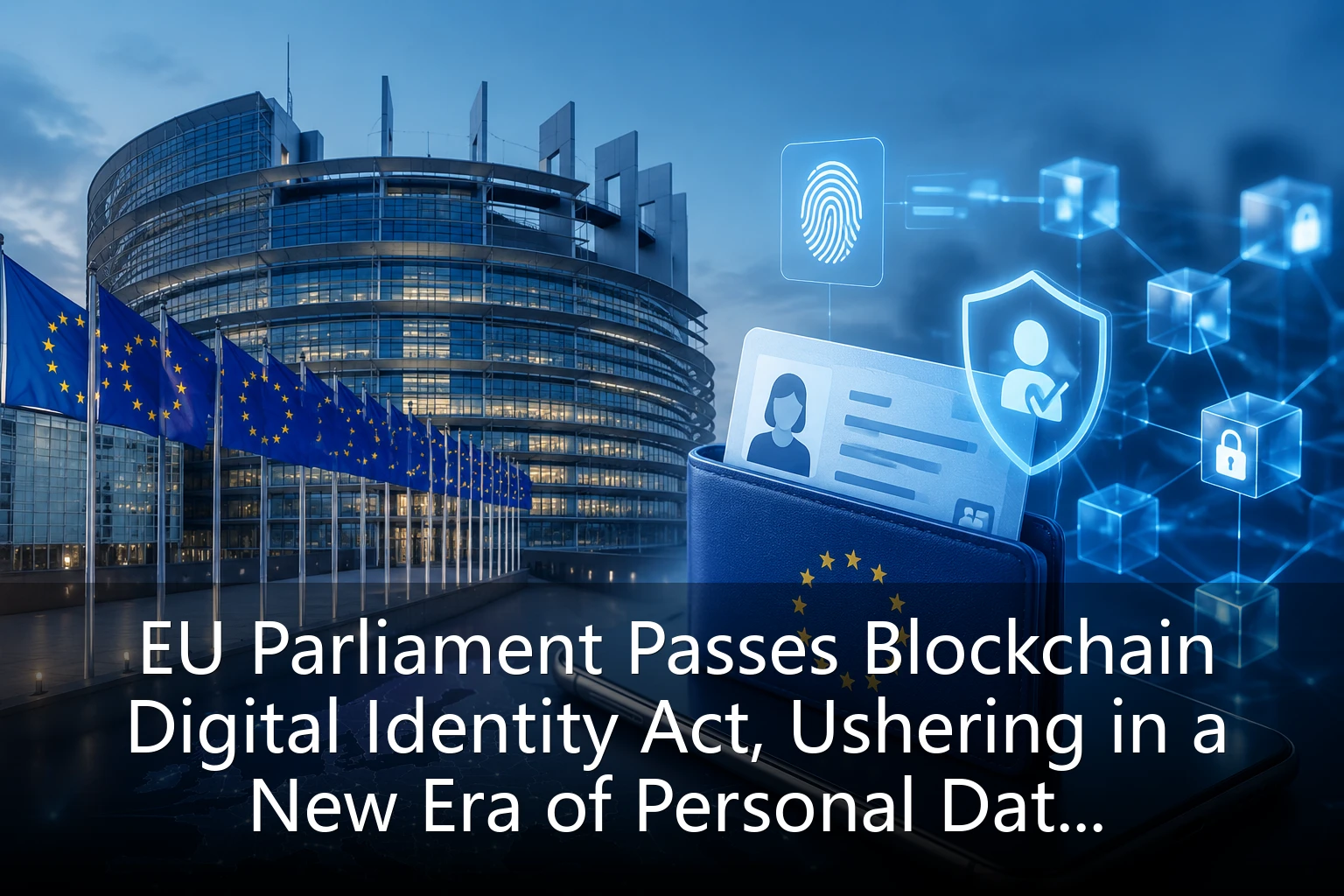
On July 28, 2026, the EU Parliament passed the historic Blockchain Digital Identity Act (BDIA) by a one-vote margin, marking the entry into the legislative phase of the world's first national digital identity framework based on distributed ledger technology. The act aims to address fragmented identity verification among EU member states while granting citizens absolute control over their personal data, considered a key step in the EU's digital sovereignty journey.
Core of the Act: Self-Sovereign Identity Enshrined as Legal Right
The core of the BDIA is the introduction of the concept of "Self-Sovereign Identity" (SSI), meaning citizens no longer rely on centralized entities like governments or corporations for identity verification. Instead, they manage and share personal information independently using encrypted credentials on the blockchain. Users can store data such as ID cards, academic certificates, bank accounts, and medical records encrypted on the chain via a digital wallet app, and selectively disclose proofs to third parties without revealing raw data when needed.
The act mandates that all EU member states must establish BDIA-compliant blockchain digital identity infrastructure by 2028 and recognize digital identity credentials issued by other countries. According to European Commission estimates, full implementation could save businesses over €12 billion annually in identity verification costs, while reducing cross-border service registration time from an average of two weeks to minutes.
Technical Architecture: Public-Private Chain Hybrid and Privacy Protection
BDIA does not mandate a specific blockchain platform but defines a set of technical standards requiring a hybrid chain architecture with "auditable privacy." Public chains record metadata such as hash fingerprints and revocation status of identity credentials, ensuring transparency and immutability; private chains or side chains handle specific transactions, guaranteeing high performance and user privacy. Additionally, the act mandates zero-knowledge proof (ZK-Proofs) technology, enabling identity verification without revealing any sensitive information—for example, proving one is over 18 to a bar without disclosing a birthdate.
The European Union Agency for Cybersecurity (ENISA) will develop unified security standards and certification mechanisms, conducting regular audits of all nodes involved in identity issuance and verification. Institutions violating data protection rules face fines up to 4% of global annual turnover, similar to GDPR enforcement.
Industry Insights: Full Potential from Finance to Government Services
The financial sector is seen as the fastest beneficiary. The European Banking Authority (EBA) immediately issued a statement saying BDIA will significantly simplify customer due diligence (KYC) processes and reduce anti-money laundering compliance costs. Anna Schmidt, Head of Blockchain at Deutsche Bank, noted: "Combining BDIA with the upcoming digital euro, users can complete remote account opening, cross-border payments, and even mortgage loans while fully controlling privacy, potentially reducing the entire process from days to minutes."
In healthcare, patients can use digital identities to encrypt and authorize doctors to access their medical summaries, breaking data silos between hospitals. Sweden and Estonia, already in pilot phases using blockchain identity systems, have seen data breach incidents drop by over 70%. Furthermore, in government services, citizen voting, property registration, and social security applications can be completed via on-chain digital identities, reducing administrative corruption risks.
Global Reactions: Challenges and Controversies
Despite BDIA's passage through Parliament, opponents argue that requiring all citizens to have a digital identity to access public services could exacerbate the digital divide. The European Digital Rights organization (EDRi) warned that if the system has backdoors or centralized control points, it could evolve into "the largest surveillance tool in history." In response, the act includes amendments explicitly banning mandatory government collection of biometric data and retaining physical identity channels for those unwilling to use digital identities.
Major economies such as the United States, China, and Singapore are closely observing the EU's practice. Hester Peirce, Commissioner of the U.S. Securities and Exchange Commission (SEC), stated: "The EU's BDIA could trigger a global competition for digital identity standards; the U.S. needs to accelerate compliant blockchain identity solutions." According to blockchain analytics firm Messari, the global digital identity market is projected to exceed $850 billion by 2030, with the EU potentially capturing around 40% market share.
Next Steps: Implementation Guidelines and Industry Pilots
The European Commission will issue detailed implementation guidelines for the BDIA within the next six months, including how different categories of identity credentials (e.g., ID cards, academic degrees, professional qualifications) are managed hierarchically, and specific technical protocols for cross-border mutual recognition. The first large-scale pilots will launch in the first quarter of 2027 in the Netherlands, France, and Lithuania, focusing on healthcare data sharing and cross-border higher education credential verification. Meanwhile, the Commission has allocated €3.5 billion to help small and medium enterprises upgrade systems, ensuring non-big tech companies can participate in ecosystem development.
Overall, the passage of the BDIA is not just a technological leap but a social experiment in data sovereignty. As Thierry Breton, EU Commissioner for Internal Market, said after the vote: "We are building a trust internet where every citizen becomes the master of their digital identity." In the coming years, how blockchain technology truly integrates into the capillaries of European society deserves global attention.

Copyright Notice: This article isTailan Global Finance AgencyOriginal content, please contact us for authorization to reproduce.