


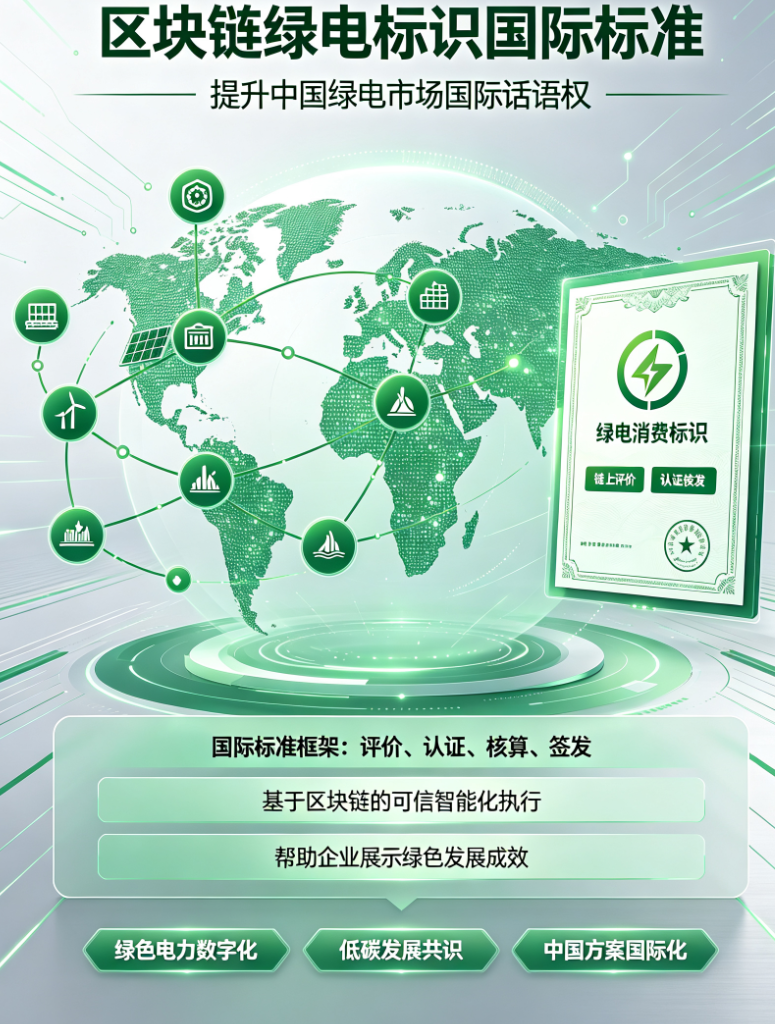
Green Electricity Trading "China Solution": Blockchain-Empowered Green Power Identification International Standard Leads Global Energy Transition
Against the backdrop of deepening global carbon neutrality goals and green development consensus, green electricity trading, as a key means to optimize energy structure and achieve low-carbon transition, is attracting widespread international attention. However, cross-border green power consumption faces challenges such as inconsistent standards, complex certification, and information asymmetry. At this critical juncture, China, by leading the development of international standards, has taken the lead in proposing a blockchain-based green power identification application solution, providing "Chinese wisdom" for global green power consumption governance.
At the Zhongguancun Forum "Digitalization Promotes Large Enterprise Innovation – AI Empowers Industrial Development Forum," State Grid Digital Technology Holdings Co., Ltd. (State Grid Xiong'an Financial Technology Group Co., Ltd.) prominently released the international standard it led to initiate — "Standard for Blockchain-based Green Power Identification Application" (IEEE P3224 Standard for Blockchain-based Green Power Identification Application). This is the first international standard in the field of green electricity trading led by China, marking a major breakthrough in China's international voice in green power consumption, and is a milestone in promoting the internationalization of the "China solution" for green electricity consumption and enhancing the international recognition of China's green power and green certificates.
I. Global Green Power Consumption Trends and China's Role
With the deepening implementation of the "Paris Agreement" and the introduction of carbon peak and carbon neutrality targets by various countries, the global energy system is undergoing unprecedented profound changes. Demand for green electricity consumption from the enterprise side is increasingly strong, from multinational corporations to local leading companies, all regarding green power procurement as an important means to fulfill social responsibilities, respond to green pressure in supply chains, and enhance brand image.
However, the internationalization of green electricity trading faces many practical obstacles. Different countries and regions have significant differences in green power certification standards, certificate transfer mechanisms, and data mutual recognition systems, resulting in high costs, low efficiency, and difficulty in trust for cross-border mutual recognition of green power consumption. Green power consumption information in the upstream of the supply chain is difficult to transmit transparently to downstream enterprises, forming so-called "green information silos."
As the world's largest producer and consumer of renewable energy, China has abundant green power resources and a mature electricity market system. Against this backdrop, the "Standard for Blockchain-based Green Power Identification Application" led by China came into being. The standard, with State Grid Corporation of China as the chair unit of the standard working group, was approved for initiation in early 2022 and passed the review of the Institute of Electrical and Electronics Engineers (IEEE) and was approved for release at the end of 2023. This is not only an output of technical specifications but also an important step for China to participate in the formulation of global energy governance rules.
II. International Standard: Dual Breakthrough in Discourse and Normative Power
In the era of industrial civilization, the power to set standards was often in the hands of a few developed countries. In the emerging field of green and low-carbon transition, China is gradually transforming from a "follower" to a "leader." The release of the "Standard for Blockchain-based Green Power Identification Application" marks China's identity switch from a "rule acceptor" to a "rule maker" in the specific track of green electricity trading.
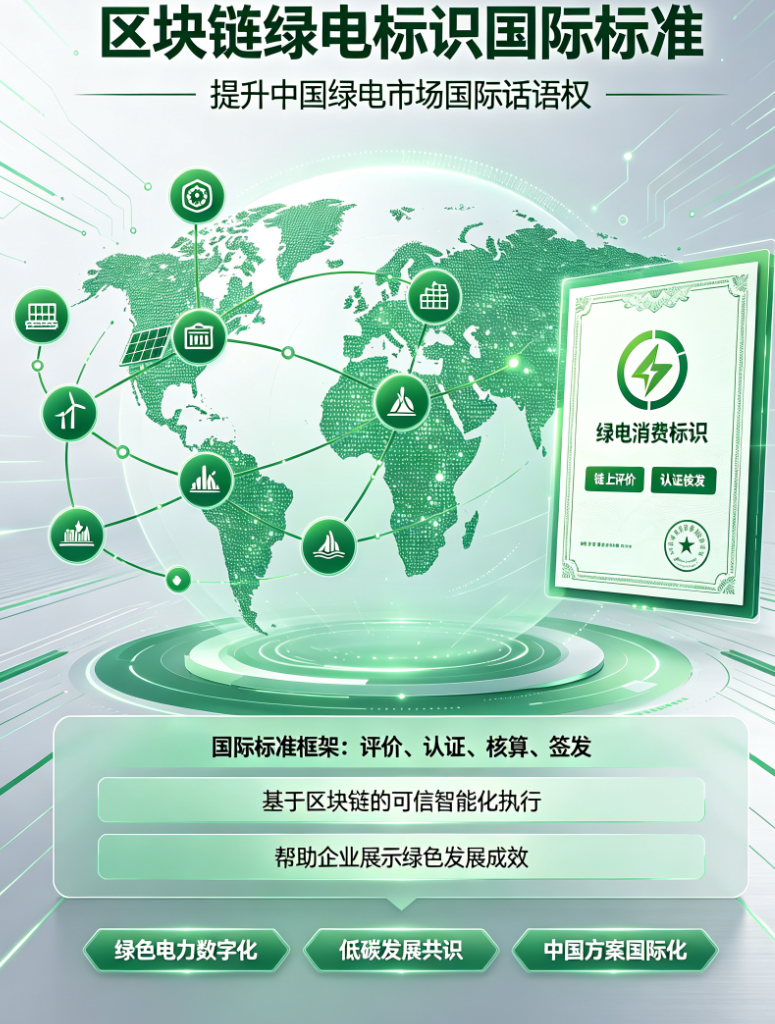
The strategic value of this standard is reflected in multiple dimensions. First, the standard proposes a blockchain-based green power identification application model and technical framework, systematically specifying technical requirements for key processes such as green power identification evaluation, certification, accounting, and issuance. This framework establishes a "weights and measures" for green power consumption, enabling green power consumption behaviors from different sources and trading models to be identified and compared under a unified scale.
Second, the standard introduces for the first time a technology-based method for generating green power consumption identifiers. This innovative design breaks the limitations of traditional manual review and centralized certification, achieving credible intelligent execution of on-chain evaluation, certification, and issuance of green power consumption identification marks. Based on the consensus mechanism, timestamp, and tamper-proof features of distributed ledger technology, every step of green power consumption is recorded in an immutable "green ledger," fundamentally solving the trust problem.
More importantly, the release of this international standard enhances China's voice in the construction of the international green power market. During the critical window of restructuring international green trade rules, mastering standard setting means holding the "ticket" to participate in rule-making, helping to promote the "China solution" globally and reduce compliance costs for Chinese export enterprises and foreign-invested enterprises in China.
III. Blockchain Empowerment: Technical Framework and Innovative Practices
The core features of blockchain technology—decentralization, immutability, traceability, and smart contracts—are highly aligned with the requirements of green power identification applications. In traditional green power certification models, data is held by a single entity, posing risks of being questioned or tampered with. Blockchain stores certification information on the chain, achieving data transparency and trustworthiness across the entire chain from power generation to trading, consumption, and certification.
The technical framework established by this standard mainly includes the following core modules:
Green Power Identification Evaluation Module: Sets multi-dimensional green power evaluation indicators, covering key parameters such as green power source type, generation time, trading path, and environmental attribute ownership. Based on a standardized evaluation model, the system can objectively and consistently generate basic data for green power identification.
Green Power Identification Certification Module: Automatically executes certification logic through smart contracts, performing real-time verification of green power consumption behavior. The certification process requires no manual intervention, significantly shortening the traditional certification cycle and reducing deviations and errors caused by human interference.
Green Power Identification Accounting Module: Enables automatic statistics, aggregation, and accounting of green power consumption data, supporting energy-consuming enterprises in accurately quantifying their green power usage. This not only provides a data foundation for internal carbon management but also offers credible support for external ESG reporting.
Green Power Identification Issuance Module: After certification, the system automatically generates a blockchain certificate containing a digital signature, timestamp, and original transaction hash, ensuring the uniqueness and unforgeability of each green power consumption identifier.
Through this technical architecture, the "data chain" of green power consumption effectively couples with the "value chain." Enterprises can verify the authenticity of consumption information without relying on a central node, thus forming a green consumption ecosystem of mutual recognition, trust, and connectivity.
IV. Application Implementation: Leap from Standard to Practice
The value of a standard lies in its application. To date, this international standard has issued the first batch of green power consumption identification certificates to pilot enterprises including Novartis Biologics and Schneider Electric, marking the initial transformation of standardization results from theoretical design to practical operation.
Novartis Biologics, as a global leading pharmaceutical company, has strict requirements for supply chain greening. By obtaining green power consumption identification based on this international standard, Novartis Biologics can not only prove its use of green electricity at its Chinese production bases but also transmit this transparent and credible data to its global headquarters for use in global EHS (Environment, Health and Safety) reports and reduction of Scope 2 emissions.
Schneider Electric, as a pioneer in green manufacturing and circular economy, has long been committed to promoting visibility and traceability of supply chain carbon footprints. The introduction of green power consumption identification helps Schneider achieve seamless alignment between the green electricity consumption of its Chinese factories and international verification standards, significantly improving the efficiency and credibility of data disclosure.
The implementation of these pilot cases verifies the technical feasibility and commercial applicability of the standard, and also provides a replicable operational paradigm for a broader range of small and medium-sized enterprises to participate in the green power market. It is foreseeable that with the gradual promotion of the standard, more and more enterprises will obtain "green identity cards," thus occupying a more competitive position in the international supply chain.
V. Future Outlook: Standardization Empowers High-Quality Development of Green Energy
The release of the "Standard for Blockchain-based Green Power Identification Application" is not the end, but the starting point for China's participation in the construction of the international energy governance system. Looking to the future, State Grid Digital Technology Holdings Co., Ltd. will take this opportunity to continuously strengthen its work on international standard development in the fields of green power and green certificates, and continuously promote the empowerment of enterprises' green and low-carbon development through standard achievements.
On the technical level, subsequent standard updates will focus on cutting-edge areas such as cross-chain interoperability, carbon footprint integration calculation, and access of large-scale IoT devices, further improving the compatibility and scalability of the green power consumption identification system. On the application level, the standard will achieve deep linkage with the domestic green electricity trading market and the national carbon emissions trading market, forming an integrated green rights management system of "electricity, carbon, and certificates."
On the international level, the "China solution" will use the standard as a carrier to actively integrate into the global green governance system. Through dialogue and alignment with the green power certification systems of countries along the "Belt and Road," RCEP member states, and the European Union, China will promote broad international mutual recognition of its green power consumption identification, contributing Chinese strength to building an open, inclusive, fair, and reasonable new pattern of global energy governance.
Conclusion
Green electricity trading is a pioneering field for energy transition, and standardization is the technical language that connects green consensus. The release of the "Standard for Blockchain-based Green Power Identification Application" marks China's historic leap from "application first" to "standard leading" in the green power field. This international standard not only provides the underlying technical framework for the standardization and traceability of global green power consumption, but also demonstrates China's responsibility and commitment in the global green and low-carbon transition process.
At present, the standard achievements have been successfully implemented at well-known enterprises such as Novartis Biologics and Schneider Electric, initially showing great potential for replication and promotion. Looking ahead, in the new era of coordinated digital and green development, this "China solution" will undoubtedly inject continuous innovative impetus into global sustainable energy development, illuminating the path to a zero-carbon future for humanity.

Copyright Notice: This article isTailan Global Finance AgencyOriginal content, please contact us for authorization to reproduce.