


Blockchain International Standards: A New Beacon for Industry Development
Keywords
Blockchain; International Standards; Electronic Invoices; Technology Empowerment; Industry Standards
Abstract
As blockchain technology enters a new phase of industrialization and scale, the establishment of international standards has become a critical high ground for industry development. This article provides an in-depth analysis of the strategic value of blockchain standardization, focusing on international standard cases in the field of electronic invoice applications. It systematically elaborates on how standard-setting empowers the industry, discussing from dimensions such as technical frameworks, application scenarios, and security governance, aiming to outline the frontier landscape and profound significance of blockchain standard construction.
I. Introduction: The Key Bottleneck in Blockchain Development
In recent years, blockchain technology, as a core infrastructure in the digital economy era, has accelerated from the proof-of-concept stage to large-scale application. From financial payments and supply chain management to government data sharing, blockchain, with its characteristics of decentralization, immutability, and traceability, is reshaping trust mechanisms and business processes in traditional industries. However, the spiral upward evolution of technology has not been smooth. An undeniable reality is that while technology is maturing and application scenarios are becoming more diverse, the lag in industry standard construction has become a key bottleneck restricting the large-scale development of blockchain.
Some industry observers point out that just as the early development of the Internet required the TCP/IP protocol to unify the world, blockchain technology also needs a set of "common language" and "operating rules." In this sense, "whoever occupies the high ground of international discourse and rule-making power will hold the key to blockchain industry development." The value of standardization lies not only in regulating technical behavior but also in reducing cross-entity collaboration costs, eliminating "information silos," and improving overall efficiency. Especially in a complex ecosystem involving globalization and multiple participants, standards serve as a bridge connecting different systems, regions, and industries.
Therefore, exploring the strategic significance of international blockchain standards and analyzing specific application cases and empowerment pathways not only has academic value but also concerns the actual direction of industry development. This article will take the latest international standards in the field of electronic invoices as an entry point, combined with blockchain technical characteristics, to systematically explore how standardization construction can become the "cornerstone" and "booster" for high-quality industry development.
II. Standards First: An Inevitable Requirement for Blockchain Industrialization
(A) From Unregulated Growth to Orderly Standards: The Strategic Importance of Standardization
In the early stages of blockchain technology development, various public chains, consortium chains, and private chains coexisted, with different technical routes, inconsistent data formats and interface protocols, and almost zero interoperability between different chains. This situation of "each acting independently" stimulated innovation vitality but also caused serious fragmentation. In enterprise-level applications, a typical dilemma is that data between multiple business systems cannot effectively interconnect, smart contracts vary greatly in invocation across different chains, and even different solutions for the same scenario face "compatibility gaps."
Standardization is the key to solving this dilemma. From the International Organization for Standardization (ISO) to national levels, countries are accelerating the formulation of blockchain-related standards. The establishment of standards helps: first, unify technical specifications and lower industry barriers; second, promote interoperability of heterogeneous systems to achieve efficient data flow on and off the chain; third, enhance security and compliance to prevent technology abuse and regulatory loopholes; fourth, strengthen international market competitiveness—countries or enterprises that dominate standard-setting will take the lead in the global industrial division of labor.
(B) Multidimensional Coverage of Blockchain Standards
Currently, blockchain standard construction covers multiple dimensions including the foundational layer, technical layer, application layer, and ecosystem layer. This includes terminology and concept definitions, evidence storage standards, smart contract specifications, digital identity authentication protocols, and cross-chain communication protocols. Each type of standard affects the actual application effect of blockchain technology. For example, in supply chain finance scenarios, without a unified standard for receivables confirmation, on-chain trust between core enterprises and suppliers cannot be effectively established; in government scenarios, without unified data sharing standards, "data islands" between different departments will persist.
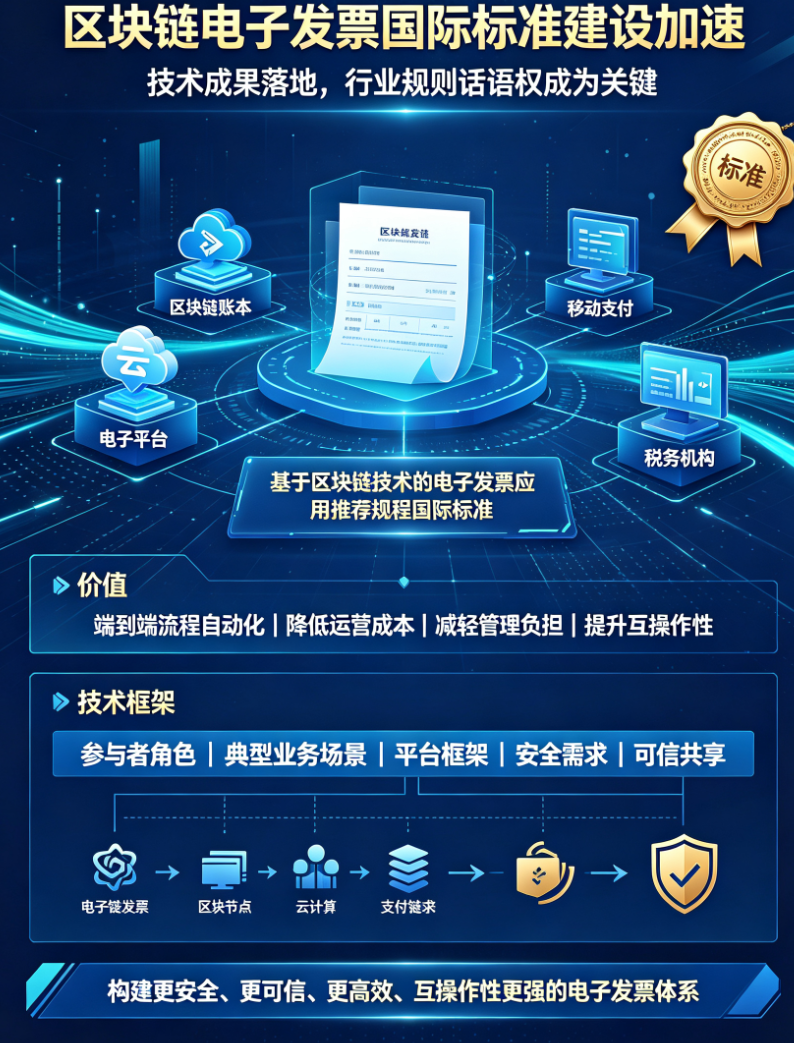
Among the many standardization achievements, the release of the international standard for recommended practices for electronic invoice applications based on blockchain technology is a milestone. This standard not only fills the gap in standardization during the digital upgrade of electronic invoices but also represents the deep integration of blockchain technology in traditional government services and commercial fields.
III. Case Analysis: Blockchain Empowering Electronic Invoice Standardization
As a basic element of the modern digital economy, the digital transformation of electronic invoices directly affects enterprise operational efficiency, tax compliance, and the construction of a social integrity system. Although traditional electronic invoices have achieved "paperlessness," they still face challenges such as security risks, opacity, and complexity caused by fragmented systems. For example, invoice tampering risks, duplicate reimbursement issues, and data incompatibility between different platforms have long plagued enterprises and tax administration agencies.
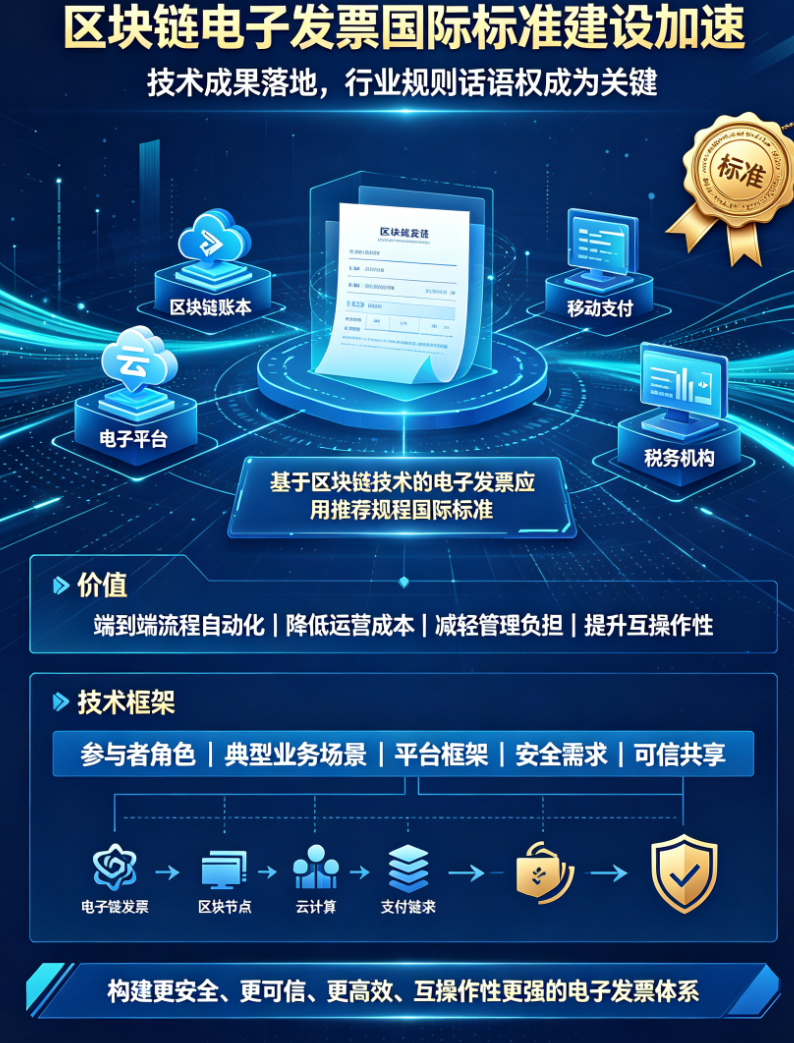
The above figure shows the core architecture of an electronic invoice system based on blockchain technology. From the figure, it can be seen that blockchain technology, through distributed ledgers, consensus mechanisms, and smart contracts, provides full-chain guarantees for the complete lifecycle of electronic invoices. This technical architecture diagram clearly shows how the "issuance-flow-verification-reimbursement" process achieves traceability and immutability within the blockchain network.
(A) Core Content and Technical Breakthroughs of the Standard
The international standard for recommended practices for electronic invoice applications based on blockchain technology integrates advanced technologies such as blockchain, cloud computing, and mobile payments. From four levels—participant roles, typical business scenarios, platform framework, and security requirements—it constructs a blockchain-based technical solution and application specification.
At the participant role level, the standard clarifies the rights, obligations, and data permissions of key entities such as the issuer, recipient, tax regulator, and platform operator. In typical business scenarios, it covers common use cases such as single transaction invoicing, batch invoicing, cross-regional bill usage, automatic reconciliation, and reimbursement. The platform framework outlines a blueprint for an electronic invoice system design that meets blockchain characteristics from the perspectives of logical architecture, data flow, and interface design. Security requirements focus on key security elements such as identity authentication, privacy protection, key management, and data encryption.
The construction of this standard is not merely a "technical retrofit" of existing electronic invoice systems but a "structural reshaping" of business processes and governance models. It fundamentally solves the three core contradictions faced by traditional electronic invoices: contradiction between security and efficiency, contradiction between privacy protection and data sharing, and contradiction between system heterogeneity and interoperability.
(B) Empowerment Effect: From "Usable" to "User-Friendly"
This international standard significantly empowers the electronic invoice business process by improving the automation level of end-to-end processes, reducing operational costs, and easing management burdens. Specifically, it is reflected in the following dimensions:
First, upgraded data security and anti-counterfeiting mechanisms. Based on the immutability of blockchain, all operational records of each electronic invoice from issuance to archiving are permanently stored on the chain, and any tampering will be detected by all network nodes. This trust mechanism of "original signature" effectively curbs problems such as "fake invoices" and "shadow invoices." For enterprise finance departments, invoice authenticity verification no longer relies on manual auditing; the system automatically compares on-chain data to complete the process.
Second, significantly improved business efficiency. Traditional electronic invoices require manual operations, and the reimbursement process is lengthy. Smart contract technology enables automatic invoice verification and expense settlement. When an invoice meets preset rules, the system automatically triggers subsequent operations such as reimbursement approval, payment execution, and accounting entries. The enterprise financial cycle is shortened from an average of 7-15 days to within 1 day.
Third, building a new ecosystem of interoperability. Electronic invoice systems of different platforms, enterprises, and regions can achieve data interconnection through standard interfaces. This means that invoice flow between an enterprise and its upstream suppliers and downstream customers is no longer limited to specific platforms, and tax regulatory authorities can also obtain full-chain data in real time to achieve intelligent risk monitoring.
IV. Industry Perspective: How Standardization Reshapes the Blockchain Ecosystem
From the electronic invoice case, we can more broadly examine the impact of blockchain standardization on the entire industry.
(A) From "Technology-Driven" to "Standard-Led"
In the early stages of blockchain industry development, technical teams were often the core driving force. Developers were keen on tackling underlying algorithms, optimizing consensus mechanisms, and improving transaction performance. However, "single-point breakthroughs" in technology do not necessarily lead to "group effects" in business. The lack of standardization has made it difficult for many excellent blockchain solutions to scale and replicate. Enterprises face "choice difficulties" when encountering different technical routes, worrying that betting on the wrong track will lead to sunk costs.
The establishment of standards provides a "lighthouse" for technology selection. Developers, enterprise users, and regulators can communicate under a unified framework, and differences in technical routes are effectively converged through standards. This not only reduces the cost of technology promotion but also allows more small and medium-sized enterprises to quickly adopt mature standardized solutions and share the dividends of the digital economy.
(B) Strategic Significance of International Standard Competition
In the global blockchain standardization process, countries have shown a strong awareness of "rule-making competition." China, the United States, the European Union, Japan, and other countries and regions are actively promoting the transformation of their national standards into international standards to gain a dominant position. Whoever dominates standard-setting will master industry discourse power and be able to convert their technical and institutional advantages into global industrial competitive advantages.
From this perspective, the release of the aforementioned international standard for electronic invoices is not only a demonstration of technical achievements but also a strategic positioning on the international standards stage. It means that China's technical accumulation, application experience, and governance wisdom in the blockchain electronic invoice field have been recognized by international standardization organizations and are beginning to influence rule-making for similar businesses globally.
V. Challenges and Outlook: Deepening Directions for Standardization
Although blockchain standardization has made remarkable progress, challenges still exist.
(A) Balance between Standardization and Innovation
An unavoidable question is: can standards inhibit innovation? Over-standardization does pose a risk, potentially limiting the diversity of technological evolution. Therefore, international standardization organizations generally adopt "recommended practices" or "reference architectures" rather than absolute "mandatory norms." In the electronic invoice international standard, the emphasis on "recommended" nature is intended to provide a set of general guidelines while retaining room for technological evolution.
In the future, standardization work needs to find a balance between "regulation" and "flexibility." On one hand, rigid requirements should be placed on core security requirements and interoperability interfaces; on the other hand, open guidance should be provided for specific implementation methods, allowing flexible adjustments based on actual business needs.
(B) Ecosystem Co-construction and Cross-Border Integration
The implementation of blockchain standards requires multi-party collaboration. Governments, industry associations, technology companies, user representatives, and academic institutions must form synergy to jointly promote standard development, testing and verification, and application promotion. At the same time, blockchain standards cannot exist in isolation; they need to coordinate with standards for big data, artificial intelligence, the Internet of Things, 5G, and other new-generation information technologies. The construction of cross-border integration standards will become a key direction for future standardization work.
(C) New Challenges in Governance and Compliance
As blockchain applications scale, new issues such as how to achieve compliant regulation of on-chain data, how to protect user privacy rights, and how to handle cross-border data flows will continue to emerge. The standard system must dynamically iterate and respond to governance needs in a timely manner. For example, the electronic invoice standard already includes identity authentication and privacy protection dimensions, but in scenarios such as cross-border data sharing and tax information exchange, more detailed compliance standards are needed as support.
VI. Conclusion: Standards as the Foundation, Chains Unlocking the Future
The value of blockchain technology lies in rebuilding trust, improving efficiency, and optimizing resource allocation. But technology alone cannot automatically achieve these goals; it requires a stable, reliable, and common set of rules as support. Standards are the core carrier of this rule system. From the successful practice of the electronic invoice international standard, it can be seen that standardization is becoming a key infrastructure for the maturity of the blockchain industry.
In this era of change, we need to look up at the stars, continuously exploring the technological frontier, and also keep our feet on the ground, taking standards as the "cornerstone" of industrial development. Every breakthrough in blockchain standard construction means a solid step forward for the industry. In the future, as standardization advances in more fields, blockchain technology will truly transform from a "laboratory tool" to a "social operating system," injecting stronger and more sustainable momentum into the development of the digital economy.
Let us look forward to the day when the chain of standards and the chain of technology complement each other, and a more efficient, transparent, and trustworthy digital world will accelerate its arrival.
Copyright Notice: This article isTailan Global Finance AgencyOriginal content, please contact us for authorization to reproduce.