


Blockchain-Driven Digital Transformation of Financial Infrastructure: Strategic Paths and Practices
Abstract
With the rapid development of the digital economy, blockchain technology, as a key force in restructuring financial infrastructure, is triggering profound changes globally. This paper systematically analyzes the strategic value of blockchain applications in accelerating the digital transformation of financial infrastructure, meeting diverse market demands, improving cross-border business efficiency, enhancing international discourse power, and safeguarding financial security. It also delves into innovative practices in blockchain-based digital bonds in Mainland China and Hong Kong. Research shows that China’s financial infrastructure, represented by CCDC, has not only filled the gap in domestic financial infrastructure supporting offshore bond issuance through its self-developed blockchain digital bond issuance public platform but also laid a solid technical foundation for participating in international financial rule-making and safeguarding national financial security.
I. Introduction
Driven by the global fintech wave, blockchain technology, with its core features of decentralization, immutability, and traceability, is reshaping the operational logic of traditional financial infrastructure. As a key supporting technology for the development of digital assets, blockchain applications are seen as a viable path to promote the digital transformation of financial infrastructure. Currently, major international financial infrastructure entities are deploying blockchain technology, and China is actively exploring practical solutions tailored to its national conditions. This paper will conduct an in-depth analysis of the strategic significance and specific practices of blockchain applications in the financial infrastructure field.
II. Strategic Significance of Exploring Blockchain Applications
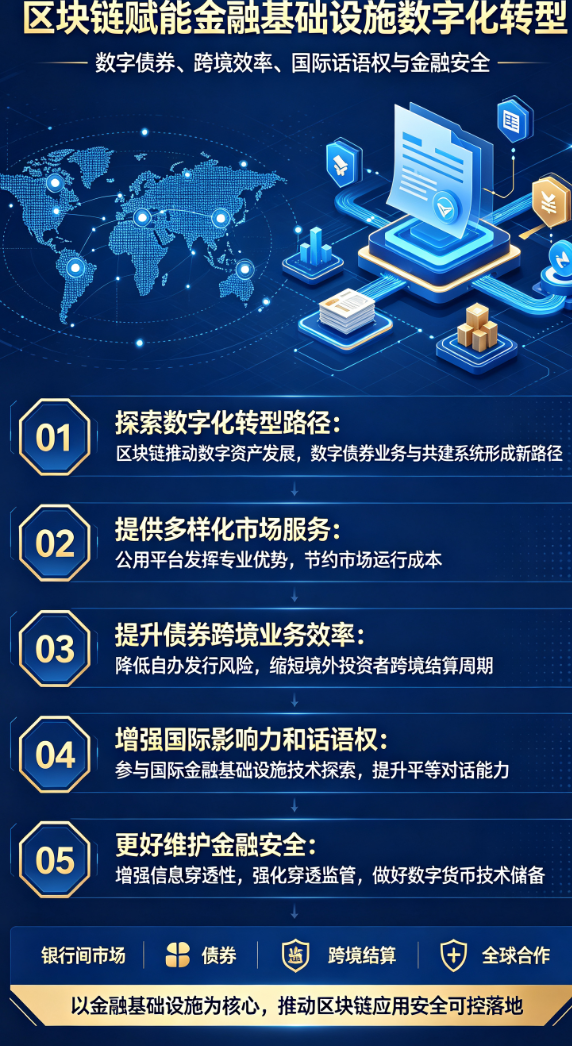
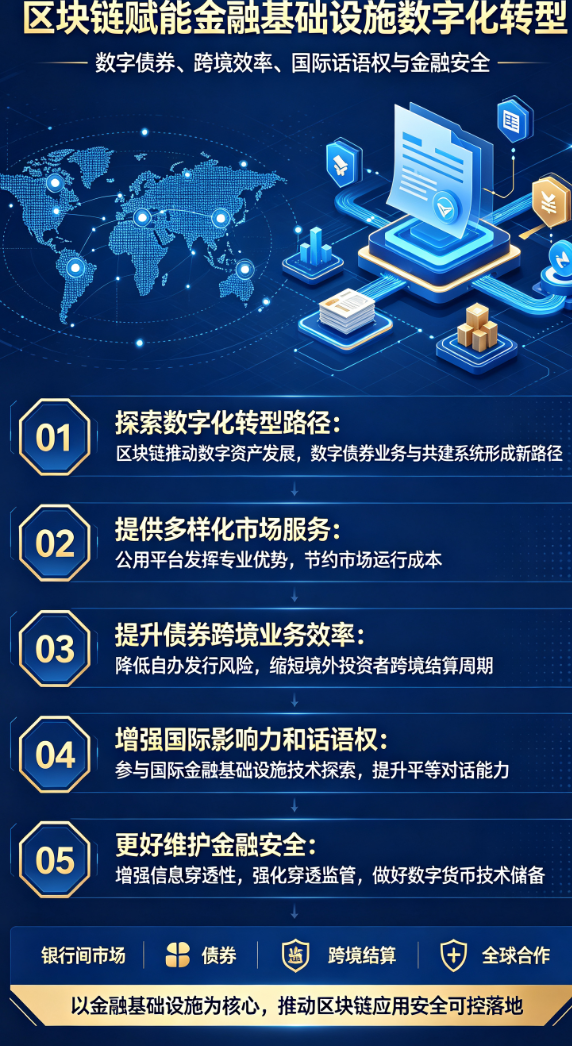
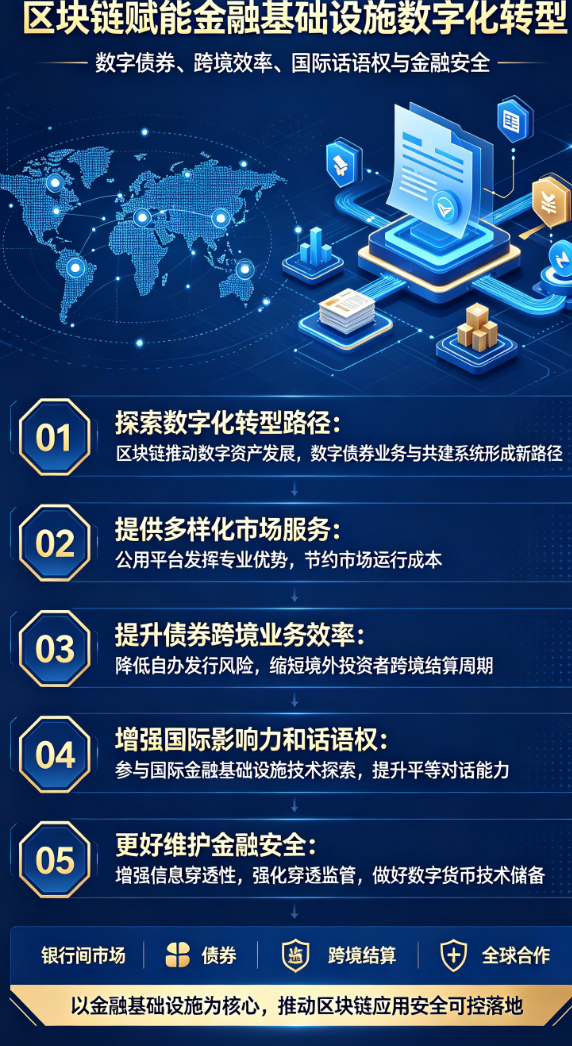
(1) Exploring Digital Transformation Paths
The application of blockchain technology provides a new technical paradigm for the digital transformation of financial infrastructure. Compared to traditional centralized systems, blockchain architecture enables real-time information sharing, multi-party collaboration, and automated execution, effectively reducing system complexity and operational costs. Financial infrastructure entities exploring blockchain digital bond businesses and jointly building blockchain systems with market institutions constitute an innovative path to promote the digital transformation of financial markets. This path not only improves market operational efficiency but also provides infrastructure support for the orderly development of future digital assets.
(2) Providing Diversified Market Services
Compared to commercial institutions building their own blockchain systems, financial infrastructure providing a unified blockchain digital bond public platform has significant advantages. On one hand, leveraging their professional capabilities and neutral position, financial infrastructure can formulate unified technical standards and business norms, avoiding market fragmentation; on the other hand, public platforms can effectively reduce the duplicate construction costs of market institutions and achieve economies of scale. By offering digital services covering the entire chain of bond issuance, registration, custody, and settlement, the public platform can better meet the diversified needs of different types of market entities.
(3) Improving Cross-Border Bond Business Efficiency
In the global bond market, offshore bond businesses other than FTZ bonds have long faced issues such as self-issuance and multi-tier custody, leading to low business efficiency and high operational risks. Financial infrastructure providing a public blockchain digital bond service platform can effectively solve these problems. Through the application of blockchain technology, full penetration and real-time sharing of bond information can be achieved, reducing the operational risks of market institutions' self-issuance, while significantly shortening the cross-border settlement cycle for overseas investors and improving overall business efficiency.
(4) Enhancing International Influence and Discourse Power
Currently, major international financial infrastructure entities such as Euroclear and Clearstream are actively exploring blockchain technology applications, attempting to conduct securities trading and settlement on blockchain. In this global competition, only through proactive exploration and practice, possessing corresponding technical support and business capabilities, can China’s financial infrastructure gain the right to equal dialogue with international peers and participate in potential international cooperation and rule-making. This is not only about technological competition but also about China’s discourse power in the international financial system.
(5) Better Safeguarding Financial Security
One of the core values of blockchain technology is enhancing information penetrability and transparency. By putting bond issuance, trading, and settlement on-chain, full traceability and auditability can be achieved, thereby strengthening penetrating regulatory capabilities. Furthermore, financial infrastructure exploring blockchain digital bonds helps prepare technical reserves for the application of digital currencies in the bond market and enhances the autonomous controllability of cross-border settlement systems. In the current international geopolitical environment, safeguarding financial security holds special strategic significance.
III. Practical Exploration of Blockchain Digital Bonds in Mainland China
(1) CCDC’s Innovative Practices
Representing China’s financial infrastructure, CCDC began exploring blockchain technology research and application as early as 2018, committed to providing the market with safer, more efficient, and diverse services. Its innovative practices show a clear progressive path: from credit asset transfer and corporate bond acceptance review to digital bond issuance, gradually deepening blockchain technology application.
In 2020, the YD Credit Asset Blockchain Platform was officially launched, utilizing blockchain’s technical features of information traceability, information storage, and multi-point collaboration to meet the strict requirements for asset penetration registration in credit asset transfer businesses. By expanding the scope of effective information sharing, the platform further enhanced mutual trust among banks. The corporate bond blockchain platform launched at the same time, based on blockchain’s immutability, transparency, and security, achieved document storage and information traceability for each link, creating an open, transparent, digital, and intelligent corporate bond service platform for regulators and market institutions.
In 2021, CCDC further explored using blockchain technology to support bond issuance, forming a complete blockchain digital bond issuance business plan and system prototype. By leveraging blockchain’s technical advantages such as encryption algorithms, privacy protection, identity recognition, and smart contracts, the transparency and efficiency of bond issuance were significantly improved, while providing technical support for strengthening penetrating regulation.
In early 2022, 16 ministries jointly issued a document designating CCDC as a national blockchain innovation application pilot, marking high-level recognition of its blockchain innovation practices. In November of the same year, CCDC launched China’s first independently controllable blockchain digital bond issuance public platform, a milestone. The platform adopts a consortium chain architecture, implements centralized management, and co-builds and co-governs with market institutions; technically, it adheres to a self-developed route, supports full nodes, light nodes, and no-node access, and achieves multiple interoperability methods such as on-chain/off-chain, homogeneous chain cross-chain, and heterogeneous chain cross-chain; functionally, it supports the full-process business of bond issuance.
By the end of 2023, the platform had successfully supported bond issuance totaling 84.54 billion yuan, covering financial bonds, corporate bonds, and FTZ bonds. The launch of this system application filled the gap in domestic financial infrastructure supporting offshore bond issuance and played an important role in promoting the integrated development of the digital economy and the real economy. Meanwhile, the platform achieved cross-chain landing applications with two representative institutions and has the capability to support regulation.
In its exploration practices, CCDC has also formed a series of standardization outcomes, including two enterprise standards, “CCDC Blockchain Digital Bond Issuance Platform Specification” and “CCDC Blockchain Digital Bond Issuance Platform Interface Specification,” one of which is the first standard in the field of blockchain digital bonds. The formulation of these standards enables the replication and promotion of excellent experience and practices, laying a foundation for the standardized development of the industry. Additionally, CCDC has conducted frontier research topics such as blockchain supporting bond lifecycle business and digital currency settlement of digital bonds, continuously driving technological innovation.
IV. Blockchain Digital Bond Practices in Hong Kong, China
As an international financial center, Hong Kong is also actively exploring blockchain digital bond businesses, showing distinctive features aligned with international markets.
In 2021, the Hong Kong Monetary Authority (HKMA) cooperated with the Bank for International Settlements to conduct simulation tests on tokenized green bonds, exploring blockchain innovation applications. In 2022, HKMA further explored the use of blockchain technology to achieve delivery versus payment (DVP) settlement of bond tokens and cash tokens, verifying the feasibility of blockchain in bond settlement.
In 2023, HKMA supported the Hong Kong SAR government in issuing tokenized green bonds, the first batch of tokenized green bonds issued by a government globally, a landmark. After the tokenized bond issuance, Hong Kong further explored using blockchain to support secondary market trading and coupon payment and redemption businesses, pushing blockchain technology to cover the full lifecycle of bonds. In August of the same year, HKMA released the “Tokenization of Hong Kong Bond Market” report, clearly proposing policy recommendations to popularize tokenized bond issuance and promote widespread application.
V. Conclusion and Outlook
The application of blockchain technology in the financial infrastructure field is not only a technological revolution but also a profound institutional innovation. From the practices in Mainland China and Hong Kong, blockchain digital bond businesses have already demonstrated significant strategic value: improving market efficiency, reducing operational costs, enhancing regulatory capabilities, and promoting cross-border cooperation.
Looking ahead, with the unification of technical standards, the improvement of regulatory frameworks, and the expansion of application scenarios, blockchain digital bonds are expected to become a core component of financial infrastructure. China’s financial infrastructure should continue to adhere to the principle of combining independent innovation with open cooperation, building on existing achievements, further exploring frontier areas such as blockchain supporting bond lifecycle businesses and digital currency settlement, and continuously accumulating practical experience and technical capabilities.
At the same time, it should actively participate in international standard setting and rule negotiation, striving for greater discourse power in the international financial governance system. Only in this way can the digital transformation of financial infrastructure be truly realized, providing solid support for safeguarding national financial security and promoting high-quality economic development.

Copyright Notice: This article isTailan Global Finance AgencyOriginal content, please contact us for authorization to reproduce.