


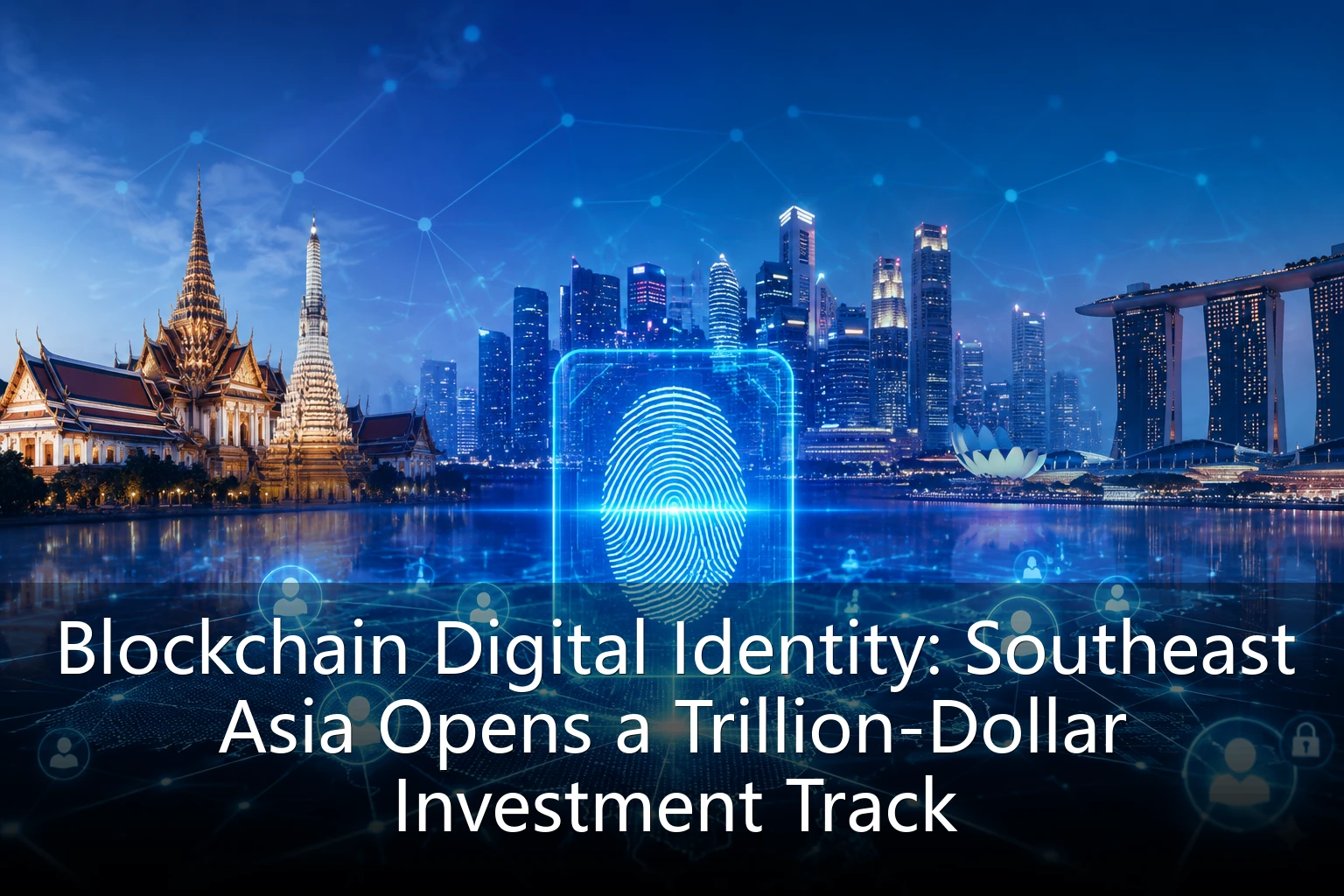
On July 26, 2026, the Bank of Thailand and the Monetary Authority of Singapore (MAS) jointly announced the successful completion of a cross-border digital identity authentication system test based on blockchain technology. The system allows residents of both countries to perform instant and secure identity verification in scenarios such as bank account opening and loan applications, eliminating the need to repeatedly submit paper documents. This milestone not only marks a crucial step for Southeast Asia's digital identity infrastructure but also sends a clear signal to global investors: blockchain technology is transforming from a cryptocurrency "speculation tool" into real economy infrastructure, with digital identity becoming the core track for the next wave of investment growth.
1. Digital Identity: The "Killer App" of Blockchain Technology
For a long time, digital identity management has faced pain points such as data silos, privacy leaks, and identity theft. Traditional centralized identity systems store user data on a single server, leaving millions of users' sensitive information at risk once hacked. Blockchain's decentralized architecture, encryption algorithms, and immutability provide a natural solution: users control their private keys, authorize only necessary data, and all operations are recorded on-chain for traceability.
The joint test by Thailand and Singapore is a practical implementation of this concept. The system is based on the Hyperledger Fabric consortium chain and uses zero-knowledge proof technology to ensure identity information is not disclosed during verification. For example, a user only needs to prove to the bank that they are "over 18 years old" without revealing their specific birth date; the bank then quickly completes the KYC (Know Your Customer) process through on-chain verification results, reducing time from days to minutes. Bank of Thailand Governor Sethaput Suthiwartnarueput stated in a declaration: "This is the first cross-border blockchain digital identity collaboration in the ASEAN region, which will greatly enhance financial service efficiency and is expected to save the banking industry more than $500 million in compliance costs annually."
2. From Finance to Everything: The Explosion of Digital Identity Application Scenarios
The value of blockchain digital identity extends far beyond finance. As industries such as IoT, telemedicine, and online education mature, identity verification demand grows exponentially. Below are the most promising application scenarios:
- Cross-border Financial Services: Beyond bank account opening, digital identity can be used for cross-border payments, securities trading, insurance claims, etc. In Southeast Asia, many overseas workers need to regularly remit money home, a process that traditionally requires multiple identity verifications. Blockchain digital identity, once authenticated, can be used across multiple locations, reducing remittance costs by over 60%.
- Healthcare: Patients can authorize doctors to access their on-chain medical records while preventing privacy leaks. A private hospital group in Malaysia has piloted migrating electronic medical records to the blockchain, reducing the time for cross-institutional record retrieval from 2 hours to 5 minutes.
- Government and Public Services: Estonia has long used blockchain digital identity for voter registration and tax filing. In Southeast Asia, Indonesia plans to cover 100 million citizens with blockchain digital identity by 2027 for social welfare distribution and land registration.
- Supply Chain Traceability: Digital identity can assign a unique "blockchain ID card" to each product, allowing consumers to scan and check origin, logistics, and quality records. Vietnamese coffee exporters have adopted this technology to gain higher premiums in the EU market.
3. Why Invest in Blockchain? A Paradigm Shift in Investment Logic
The volatility of the cryptocurrency market once made investors skeptical about blockchain technology. However, in 2025-2026, institutional capital is pouring into blockchain infrastructure. According to CB Insights data, global blockchain startup financing in the first half of 2026 reached $18.2 billion, with digital identity accounting for over 35%, a 210% year-on-year increase. Three core logics drive this trend:
3.1 Compliance and Regulatory Implementation
Central banks and regulatory bodies worldwide are accelerating the development of digital identity standards. In October 2025, the International Organization for Standardization (ISO) officially released the blockchain digital identity international standard ISO 23220, providing a framework for cross-system interoperability. Compliance reduces policy risks, with large companies (such as Microsoft, IBM, and Ant Group) now dominating the market rather than early rogue projects. For investors, this means a safer entry window.
3.2 The Foundation of DeFi 2.0
Digital identity is key to transitioning DeFi from "anonymous lending" to "compliant financial services." Traditional DeFi users only need a wallet address, but the lack of credit backing leads to high collateral ratios and frequent bad debts. With blockchain digital identity, users can link on-chain credit records to achieve "unsecured lending" based on identity. Thai fintech company Lightnet has launched such products with annualized interest rates 40% lower than traditional microloans.
3.3 Economic Effects of Data Sovereignty Awakening
Over the past decade, tech giants have profited from user data while users gained almost nothing. Blockchain digital identity returns data ownership to individuals: users can authorize companies to use their data and receive token incentives. Klaytn, the blockchain platform under Korean tech giant Kakao, launched a "Data Revenue" program where users share browsing behavior data to earn KLAY tokens, reaching 8 million users within three months. This model is being replicated in Southeast Asia; Indonesian e-commerce platform Tokopedia plans to launch similar features by the end of 2026.
4. Investment Targets and Risk Warnings
Currently, investors can participate in the blockchain digital identity track through the following channels:
- Digital Identity Protocol Projects: Such as Polygon ID, Ontology, and Civic, which provide underlying technical frameworks whose value grows with network adoption. Polygon ID has partnered with Thai taxi service Grab for driver background checks.
- Listed Company Layouts: Microsoft's Azure Active Directory has integrated blockchain identity verification; Japan's Fujitsu has collaborated with Union Bank of the Philippines to develop a digital identity platform. In addition, Southeast Asian local giants like Thailand's Ascend Group (which owns TrueMoney) are also deploying related businesses.
- ETFs and Funds: The world's first "Blockchain Digital Identity ETF" is listed on the New York Stock Exchange (ticker IDEN), comprising 30 constituent stocks including Civic, Microsoft, and Fujitsu. The ETF has returned 78% since its listing in September 2025.
However, risks remain: insufficient technological maturity (e.g., cross-chain interoperability still faces challenges), balance between user privacy and regulation (different countries have varying data localization requirements), and intensified market competition (traditional SIM-based KYC solutions still have cost advantages). Investors should diversify their portfolios and avoid betting on a single project.
5. Conclusion: Infrastructure Before Applications
Looking back at the history of the internet, it was the perfection of infrastructure like the TCP/IP protocol and the Domain Name System (DNS) that gave rise to the trillion-dollar e-commerce and social network industries. Blockchain digital identity is precisely the infrastructure of the Web3.0 era. With the successful cross-border test between Thailand and Singapore and the accelerated push for "digital identity blueprints" across Southeast Asia, 2027 is expected to be the explosive year for commercial blockchain digital identity. For investors, the answer to "Why invest in blockchain?" is clear: invest not in coin price volatility, but in the restructuring of human identity rights in the digital age. Whoever secures this "on-chain ID card" first will gain the ticket to the next generation of the internet.
Copyright Notice: This article isTailan Global Finance AgencyOriginal content, please contact us for authorization to reproduce.